Ex-Meta FAIR Scientists Open-Source Isaac 0.5, a Vision Model That Lets Industrial Robots Perceive, Reason, and Act
Perceptron, a startup founded by two former Meta FAIR researchers, has released Isaac 0.5 — an open-weight vision model trained on a million hours of video, built to guide robots through warehouses and factory floors without cloud GPUs.
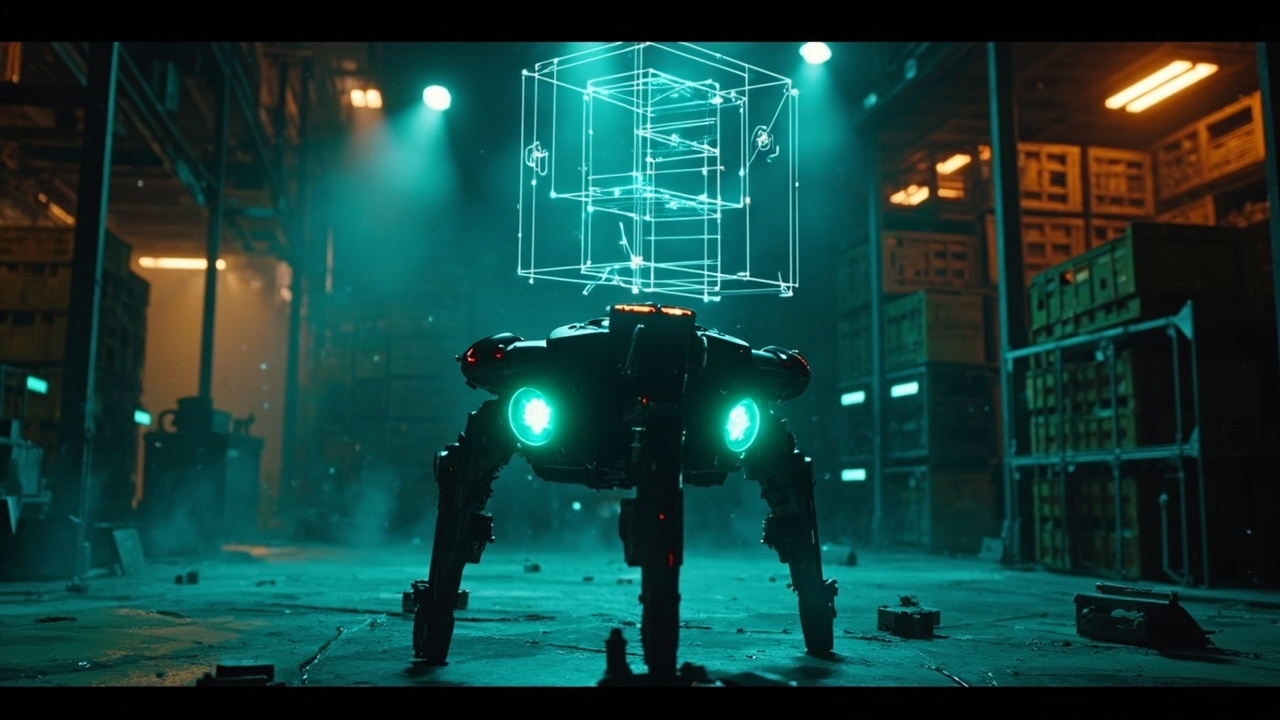
While the AI industry’s attention remains fixed on chatbots and coding agents, a quieter branch of the field has been working on a much harder problem: giving machines eyes that actually work. This week, Perceptron — a startup founded in November 2024 by two former Meta FAIR research scientists — launched Isaac 0.5, a vision model designed to help industrial robots “perceive, reason and act” in the messy, unpredictable environments where real automation happens.
Unlike the general-purpose chat models that dominate headlines, Isaac 0.5 is purpose-built for the physical world: guiding vision-directed robots through warehouses and factory floors, and extracting visual intelligence from the video those robots record along the way. And in a move that separates it from most frontier-lab releases, the model ships as an open-weight release — anyone can download the parameters and inspect the training materials.
What Isaac 0.5 Actually Does
The core pitch from founders Armen Aghajanyan and Akshat Shrivastava is that physical AI today forces what they call a “false choice”: generalist foundation models that need multiple dedicated cloud GPUs for every instance, or narrow models that handle perception or control — but never both.
Isaac 0.5 is designed to collapse that trade-off. It’s a general-purpose model, not a single-task system trained to do one repetitive job. Instead, the model adapts to the particular environment and situation it finds itself in.
Co-founder Akshat Shrivastava walked TechCrunch through the example of a robot sorting packages — a task that sounds simple until you decompose it:
- Read the label on each package.
- Perform spatial analysis to understand where the boxes are in the scene.
- Decide which box to pick up, and if it’s picking up multiple boxes, plan the order of operations.
Each of those steps individually is a solved problem in robotics. What’s rare is a single software layer that can flexibly handle all of them, in sequence, in environments it wasn’t explicitly programmed for.
The Data Story: A Million Hours of Video
Where does training data for an industrial vision model come from? Perceptron’s answer is scale — a million hours of general video to teach the model to recognize settings, visuals, and scenarios, supplemented by two more specialized categories:
- Ego video — footage captured from a wearable camera or GoPro from the perspective of a person completing a physical task, teaching the model a first-person view of manipulation.
- UMI video — recordings of repetitive human actions, used to teach AI systems the movements themselves.
The company isn’t disclosing the specific sources of its training data, but Shrivastava says Perceptron has “internally built petabyte-scale datasets that span across modalities, whether it’s images, text, video, etc. all the way through robotic trajectories.”
That dataset breadth is the moat. Frontier labs can train on the public internet; physical AI requires data that captures how the world behaves when you push on it — and that data mostly doesn’t exist on the open web.
Why Open Weights Matter Here
The decision to release Isaac 0.5 as an open-weight model is notable for two reasons.
First, industrial customers are conservative. Factories don’t outsource their perception stack to an API that could change behavior — or disappear — next quarter. An open-weight model that runs on-premise, on hardware the customer controls, fits procurement requirements that closed APIs can’t touch.
Second, it signals where Perceptron thinks the physical AI market is going. The startup is marketing Isaac 0.5 to a wide range of vendors across manufacturing, logistics and warehousing, security, mobility, and media and entertainment. The bet is that its intelligence layer becomes the default brain inside other companies’ robots — a horizontal play, not a vertical one.
“Nothing like this really exists out there,” Aghajanyan told TechCrunch. “We’re really excited about it.”
Context: The Physical AI Wave
Perceptron’s launch lands in the middle of a broader shift. After two years of text-centric AI investment, capital and talent are rotating toward “physical AI” — models that operate in the real world. NVIDIA has repositioned itself around robotics as its next growth pillar; Figure, Physical Intelligence, and a wave of well-funded startups are racing to build general-purpose robot foundations; and the open-weight ecosystem has demonstrated (with Kimi K3’s 2.8T-parameter release in July) that open models can genuinely compete at the frontier.
Isaac 0.5 sits at the intersection of these trends: an open-weight, general-purpose, industrial-focused vision model from a team with serious FAIR pedigree. It is not the largest model ever released, nor the most hyped. But it is exactly the kind of unglamorous, infrastructure-level release that determines who actually wins the industrial automation market — the layer beneath the flashy demos, where robots have to work all day without a human watching.
Notably, an earlier version of the TechCrunch story misreported the company’s recent funding round, and the article was updated to correct it — a reminder that even the physical AI beat is moving fast enough to trip up reporters.
The Bottom Line
Most AI news this year has been about models that talk. Isaac 0.5 is about models that look — and then decide what to do with what they see. If Perceptron’s bet is right, the next phase of AI value creation won’t come from better chat interfaces but from vision systems that can be dropped into any warehouse, factory, or security deployment, run on local hardware, and figure out the scene on their own.
For an industry that has spent a decade teaching computers to write, the factory floor is a refreshingly concrete benchmark. Aghajanyan and Shrivastava, coming out of FAIR — the lab that gave the world PyTorch and a generation of open research — are betting their credentials that open weights and physical intelligence are the same bet. The million hours of video say they’re serious.
Sources
- [1] https://techcrunch.com/2026/08/26/ex-meta-scientists-want-to-bring-visual-ai-to-the-factory-floor/
- [2] https://bitcoinworld.co.in/perceptron-isaac-0-5-robotics-ai/
- [3] https://www.perceptron.inc/about
- [4] https://www.businesswire.com/news/home/20260512066109/en/Perceptron-AI-Launches-Physical-AI-Model-That-Matches-Frontier-Labs-at-a-Fraction-of-the-Cost