World First: Live AI Guides Brain Surgery, Saves Patient's Sight
Surgeons at London's National Hospital for Neurology and Neurosurgery have performed the world's first live AI-assisted brain tumour removal, with the AI reading the surgical video feed in real time.
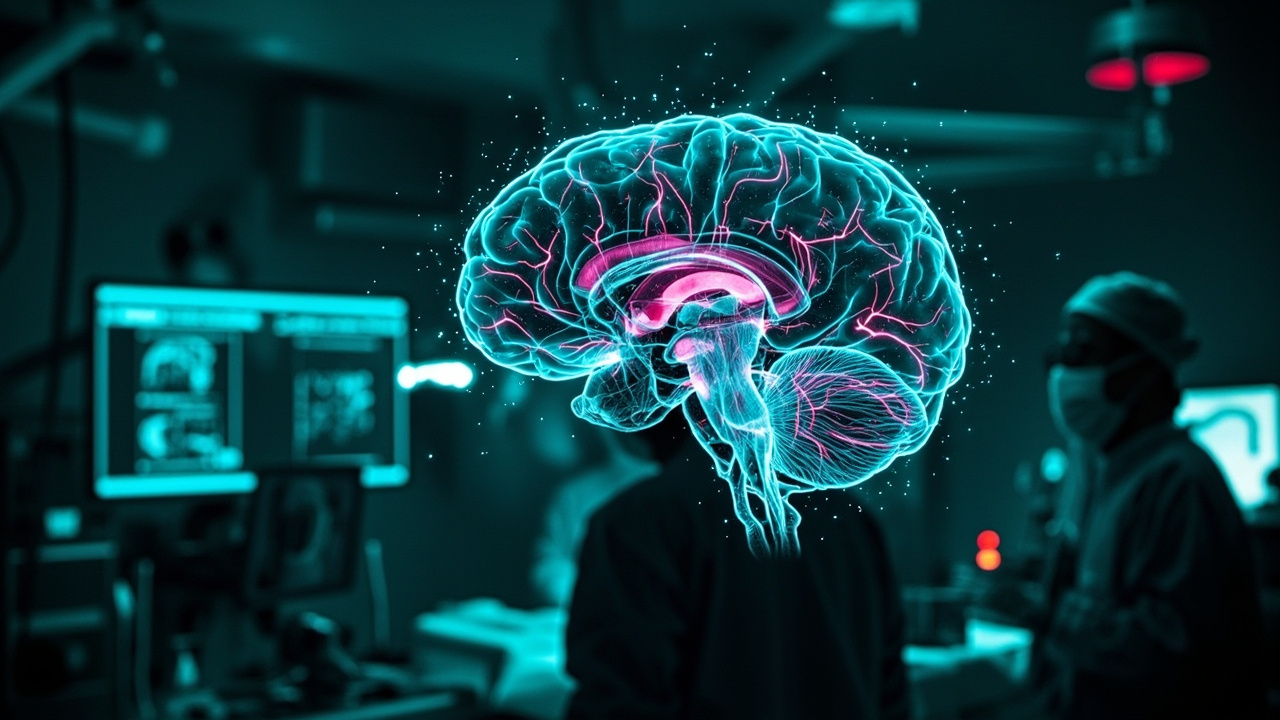
Surgeons in London have performed the world’s first brain surgery guided by artificial intelligence operating in real time — and the operation not only removed the patient’s tumour but saved his vision.
The procedure took place at the National Hospital for Neurology and Neurosurgery (NHNN), part of University College London Hospitals (UCLH), and was revealed on 27 August 2026. The patient, 48-year-old Rhys Hibbert from Bedfordshire, had an 11mm non-cancerous tumour growing on his pituitary gland — a marble-sized organ at the base of the skull that secretes hormones regulating growth, metabolism, blood pressure and body temperature. Left alone, the tumour would have kept pressing on his optic nerves and could ultimately have blinded him.
What makes this a world first
Plenty of AI tools already help surgeons — but almost all of them work with scans taken before the operation. This system is different: it watched the actual surgical video feed as the operation unfolded, analysing it frame by frame, and advised the team on how to avoid critical blood vessels and nerves hidden behind layers of bone and membrane.
The approach is called endoscopic transsphenoidal surgery: a thin camera on a flexible instrument is inserted through the nose to reach the base of the skull. It is minimally invasive, but it is also a procedure with almost no margin for error. The pituitary gland sits tightly packed against the carotid arteries — the main vessels supplying blood to the brain — and the optic nerves that control vision. In that anatomy, going a single millimetre wrong can be the difference between a clean removal and death, blindness or stroke.
The stakes explain the complication statistics the team quoted: a 25–50% chance of leaving part of the tumour behind, and a 0.5–2% chance of injuring a major blood vessel.
On a second screen in the operating theatre, the AI analysed the live feed, tracked the surgical instruments, and colour-coded the anatomy — marking where vessels and nerves were most likely to be and highlighting the zones where it was safest to work. Prof Hani Marcus, the consultant neurosurgeon who performed the operation alongside surgical resident Danyal Khan, compared the underlying technique to the facial recognition on your phone, except trained to recognise hidden anatomical structures instead of faces.
Trained on more operations than a surgeon sees in a lifetime
The system was developed at the UCL Hawkes Institute, a multidisciplinary group focused on healthcare technology. Its technical lead, Dr Sophia Bano, Associate Professor in Robotics and AI at UCL Computer Science, explained the training recipe: researchers took hundreds of endoscopic pituitary surgery videos from previous operations and carefully annotated them — drawing around the vessels and nerves in every frame — until the model learned to “recognise” the structures that matter most.
That scale is the point. The average UK surgeon performs only 10 to 20 of these operations per year, and normally relies on pre-operative scans to memorise each patient’s anatomy. The AI, by contrast, has effectively studied more pituitary operations than most surgeons will ever see.
“It is trained on more operations than most surgeons see or do in a lifetime and can act like an expert second pair of eyes,” Prof Marcus said — adding that unlike other experimental tools, this one works in real time.
The hardware matters too: the system runs on an NVIDIA Clara IGX platform, a compute box purpose-built for deploying real-time AI in medical device settings, where latency and regulatory compliance are both hard constraints. The trial was funded by the National Institute for Health and Care Research (NIHR) and Google, and supported by the NIHR Biomedical Research Centre.
The patient’s view — and the surgeons’ caveat
Hibbert’s symptoms began 18 months ago, when he collapsed mid-walk and started fitting in the road. A scan found the tumour; as it pressed on his optic nerves his peripheral vision narrowed, and he became severely fatigued and dizzy. Offered the chance to be the first patient in the trial, he did not hesitate: “If patients are not prepared to join research, how can doctors ever learn and how can medicine ever progress?”
Eight weeks after surgery, he reported sight that keeps improving every few days. “When I opened my eyes after the operation it felt like I had got 360-degree vision — I hadn’t seen that clearly for a year,” he said. “It’s given me my life back.”
He also noted the historical resonance: NHNN was founded in 1859 as the world’s first dedicated neurosurgical hospital, making it “very fitting” in his words that the same institution should now be first to carry out AI-assisted neurosurgery.
The team is emphatic about what this is not: an autonomous robot surgeon. The AI assists; the surgeons retain full control at all times. Their long-term ambition is a kind of “ChatGPT for surgeons” — an always-available expert in the room that a surgeon can consult mid-operation, or ignore if they disagree with it. The technology had previously been evaluated as a training tool for surgeons learning the procedure, and a larger clinical trial is now being planned.
Why it matters beyond neurosurgery
This is one of the clearest demonstrations yet of AI stepping out of the radiology reading room and into the operating theatre itself, under the strict safety regime of a government-funded clinical trial. Health Innovation Minister James Frith called it “an example of AI at its best: patients getting care previously deemed unimaginable,” while stressing that “AI needs proper safeguards and we will always ensure that safety is taken seriously.”
The template here — a small, well-scoped real-time perception task layered on top of an existing surgical workflow, rather than a wholesale replacement of the surgeon — is likely the pattern by which AI enters high-stakes medicine: narrow, supervised, auditable, and measured against hard endpoints like vision preservation and complete tumour resection. If the larger trial confirms the early results, live AI assistance could become standard equipment for delicate procedures where millimetres decide outcomes — and the operating room may finally get its expert second pair of eyes.