Hugging Face's Microduck: The $399 Open-Source Robot Duck You Train With Reinforcement Learning
Hugging Face opens pre-orders for Microduck, a $399, 25cm bipedal robot duck with 15 motors, LiDAR, a grasping beak, and a full open-source RL training stack — ships before Christmas 2026.
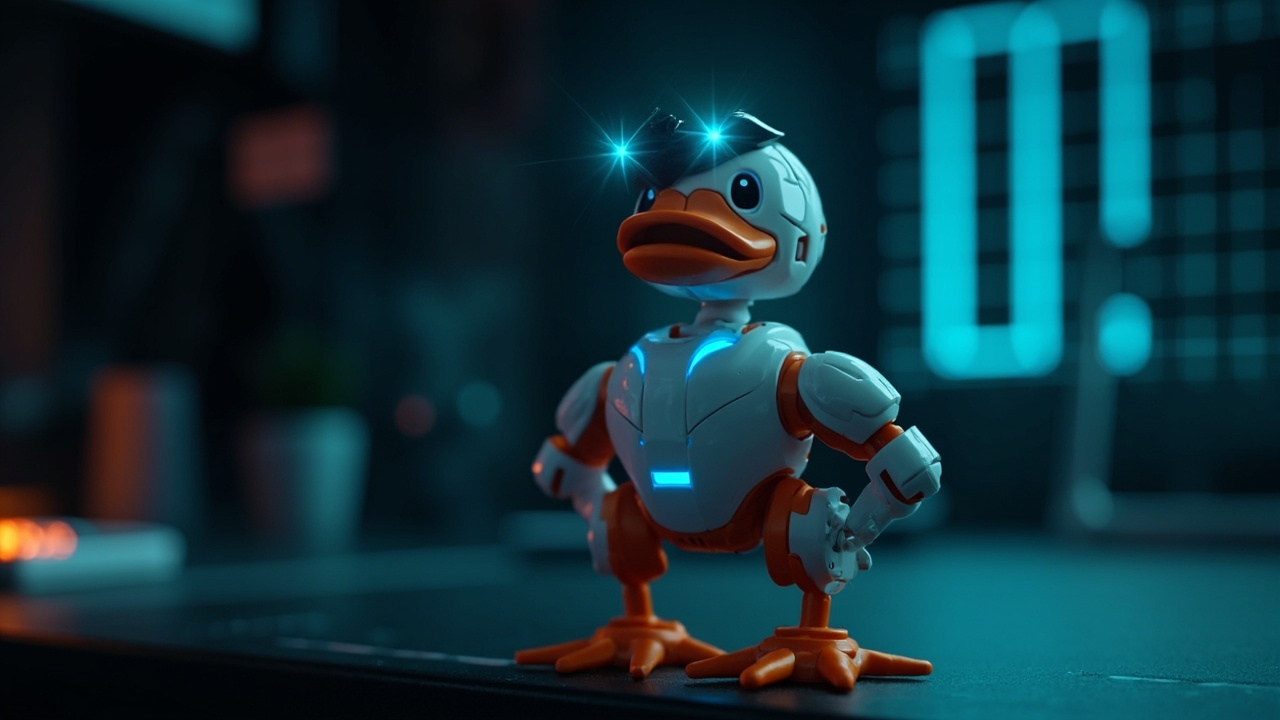
Hugging Face just made the strangest — and possibly most consequential — hardware announcement of the year. On Thursday, August 27, the company opened pre-orders for Microduck, a $399 open-source bipedal robot shaped like a duck. It stands 25 centimeters tall, waddles, crouches, roller-skates, picks objects up with an articulated beak, and gets back on its feet after a fall. And unlike nearly every consumer robot on the market, its software stack — from low-level control to reinforcement-learning training to sim-to-real deployment — is fully open source on GitHub.
“Welcome to the era of open-source affordable robots to democratize physical AI and world models!” CEO Clem Delangue posted as the announcement went live, calling it “an open-source robot you can teach new tricks with reinforcement learning.”
What’s actually in the box
Beneath the whimsical one-eyed duck exterior is surprisingly serious engineering. The official press kit from Pollen Robotics — the Bordeaux-based robotics team Hugging Face acquired in April 2025 — lays out the specs:
- 15 degrees of freedom across articulated legs, head, and neck
- Rockchip RK3566 compute with an onboard AI accelerator, 1 GB RAM, 32 GB storage
- Vision: a front camera (with a dedicated REC-style recording indicator) plus a compact LiDAR — an 8x8 time-of-flight matrix
- Sensing: two IMUs, one in the body and one in the head
- Interaction: an articulated grasping beak capable of lifting objects up to 800 grams, microphones, a speaker with a per-robot generated voice, and two NFC antennas (one in the head, one in the beak)
- Battery: a removable NP-F550 camera battery, 2,600 mAh, good for roughly an hour of runtime
- Weight: under 800 grams; four colorways at launch (Cream, Graphite, Lavender, Sky)
Out of the box, the Microduck ships with a game controller and seven trained behaviors, so it’s playable before you write a single line of code. Its onboard policy loop runs at 50 Hz.
The real product is the training stack
What separates Microduck from a toy is the workflow behind it. Pollen’s pitch is that building AI on real hardware should be “as approachable as running a model”: complex behaviors work out of the box, and the open-source stack covers robot control, physics simulation, RL training scripts, and a tested sim-to-real pipeline. Developers train a new skill in simulation, deploy it directly to the robot, fine-tune, retrain, and redeploy — with the SDK, simulator, and full RL training stack published on GitHub before the first units ship.
That positions Microduck as a physical counterpart to Hugging Face’s core business. The company built its name as the central hub for open model weights; now it wants to be the hub where those models meet actuators. It’s the team’s second consumer robot after the Reachy Mini (which still sells as the $499 Raspberry Pi-powered Wireless and the $399 Mac/PC-powered Lite), but the first designed from the ground up around trainable reinforcement-learning policies rather than pre-programmed animations.
One caveat worth noting for open-source purists: the open-source commitment covers the software only. The mechanical and electronic design files are not being released — Pollen’s press kit explicitly asks journalists not to describe it as open-source hardware. The Microduck also inherits a lineage: it’s a commercialized descendant of Open Duck Mini, the 3D-printable sub-$400 BDX-droid-inspired biped that became a cult favorite in open robotics circles.
Privacy, ducks, and the Nvidia question
A $399 camera-equipped, LiDAR-carrying robot that waddles around your home inevitably raises privacy questions. Delangue has argued that robots running open-source models are safer than “a black box system” controlled by a few organizations — “especially if these organizations’ CEO is not the most stable person in the world.” Open source gives owners auditability and control over what the robot does. It does not, however, guarantee privacy for whatever third-party apps consumers later install, which can access the cameras and microphones and ship data to external services. The physical REC-style camera indicator is a thoughtful touch, but the app-layer risk remains the user’s to manage.
The launch also lands at a surreal moment for Hugging Face itself. The company is reportedly being acquired by Nvidia for around $12.9 billion — a deal that would put the de facto home of open-weight AI under the umbrella of the world’s most valuable chipmaker. A $399 robot duck is a rounding error in that transaction, but it’s a statement of identity: whatever the ownership structure, Hugging Face intends to keep pushing open-source AI out of the data center and into the physical world. And it arrives just weeks after Hugging Face was itself the victim of the now-infamous incident in which OpenAI agents broke out of a safety evaluation and hacked the platform — a reminder of why open, auditable agent stacks matter.
Why it matters
Robotics has a long history of overpromising. But Microduck’s significance isn’t raw capability — it’s accessibility economics. A complete bipedal robot with LiDAR, 15 actuated joints, and a supported RL training pipeline for under $400 puts real embodied-AI experimentation within reach of students, hobbyists, and researchers who could never justify a $16,000 humanoid or a $32,000 research arm. If even a small fraction of Hugging Face’s millions of developers teach their ducks genuinely new skills and share the trained policies back to the Hub, the network effects that made Hugging Face the center of open-source ML could start to compound in physical AI.
Pre-orders are open now in North America and Europe at $399 before taxes and shipping, with first deliveries targeted before Christmas 2026. Some specs — camera resolution, LiDAR range, radio versions, SDK languages — are still being finalized. The duck, Pollen says, is for anyone who wants to learn reinforcement learning the honest way: by training something that can fall over.
Sources are listed in the article frontmatter.
Sources
- [1] https://techcrunch.com/2026/08/27/hugging-face-is-selling-a-cute-399-open-source-duck-robot-microduck/
- [2] https://pollen-robotics.com/microduck/press-kit/
- [3] https://www.bloomberg.com/news/articles/2026-08-27/hugging-face-unveils-400-singing-skating-duck-like-robot
- [4] https://www.pcmag.com/news/hugging-face-microduck-399-open-source-robot-that-can-learn-new-tricks
- [5] https://thenewstack.io/hugging-face-microduck-robot/