Offshore Nuclear Barges Could Power AI Data Centers—Starting in California, Where Nuclear Is Banned
The Port of Long Beach is partnering with startup Bluecore Energy to deploy small modular reactors on floating barges—clean power for ports, ships, and AI data centers in a state that banned new nuclear plants in 1976.
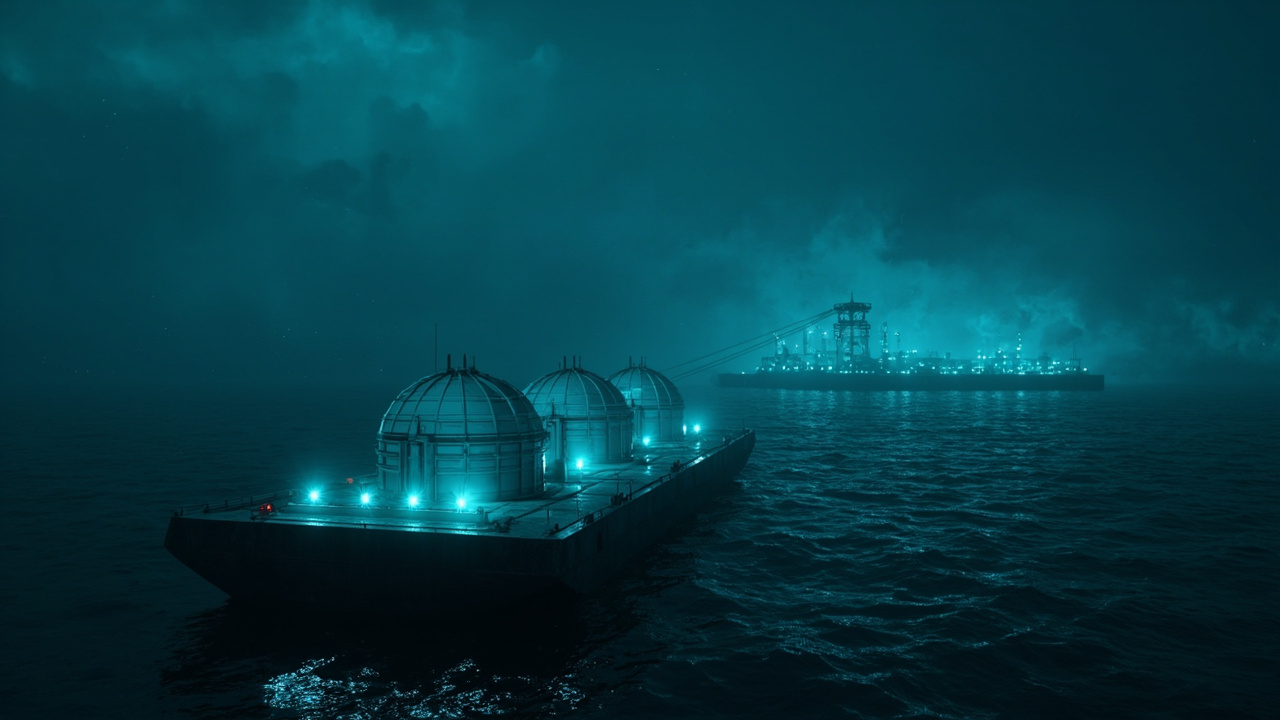
The AI data center boom has run into a wall, and the wall is made of gigawatts. As hyperscalers queue up for power faster than utilities can build it, the search for firm, carbon-free electricity has drifted somewhere unexpected: out to sea. On August 29, Fortune’s energy editor Jordan Blum laid out the newest frontier in that search—small modular reactors (SMRs) mounted on floating barges, moored off the coast to power ports, merchant ships, and AI data centers. And in one of the story’s stranger twists, the momentum may start in California, a state that has banned new nuclear plant construction for fifty years.
The Long Beach experiment
This summer, the Port of Long Beach signed an agreement with the Trump administration to develop next-generation SMRs that could deliver emission-free energy to ports, data centers, and vessels. The port is now working with a local startup called Bluecore Energy to build the reactors on floating barges—a project both sides acknowledge is still years from reality.
The scale of the stakes is hard to overstate. Long Beach and the adjoining Port of Los Angeles together form the largest container port complex in the Western Hemisphere, and the electrification of ships, cranes, and terminal equipment is driving demand for clean power that the local grid simply cannot supply. Meanwhile, the AI buildout along the West Coast competes for the same electrons.
Bluecore is an unusual company in an unusual position. Founded only in January 2026, it raised a $10 million pre-seed round and quickly became the first nuclear company to partner with the U.S. Maritime Administration (MARAD) on offshore reactors. It has already delivered its first barge to its headquarters inside the Port of Long Beach, where it is developing and testing its systems.
Founder and CEO Kofi Asante, 31, a Ghanaian-American entrepreneur from Austin, Texas, built his logistics and maritime expertise at Uber Freight, heavy-cargo drone company Elroy Air, and electric barge startup Arc before founding Bluecore. His reasoning is disarmingly simple. “The philosophy was really process of elimination: if you need that much energy, then you arrive at a nuclear reactor,” Asante told Fortune. “And if you need real estate, two-thirds of the world is water, so you can use barges for extra real estate.”
How a floating reactor works
The technical concept is less exotic than it sounds. Nuclear submarines and aircraft carriers have run on small reactors for decades, and in 2020 Russia put the world’s first floating nuclear power station—the barge Akademik Lomonosov—into service, powering the Arctic town of Pevek and its harbor.
Bluecore’s design uses smaller versions of traditional light-water reactors. Each 10-megawatt unit sits on a barge, can power roughly 10,000 homes, can be moved by tugboat, and—crucially—can be stacked alongside identical units to scale output. The barges don’t even need to sit at the port itself. “We can go miles away and connect via subsea cable—so we don’t have to be near neighborhoods, and we don’t have to be co-located at the port,” Asante explained.
Safety arguments follow the maritime playbook. Asante says the floating plants are mobile enough to be repositioned ahead of severe weather, shielded to withstand extreme conditions (including sitting underwater), and equipped with multiple automatic shutdown mechanisms. Water itself becomes the ultimate heat sink. Analyst Max Hopkins of CITIC CLSA adds that modern fuel design wraps uranium pellets in multiple layers of ceramics and graphite that render them inert when separated.
The economics argument is about manufacturing. Asante likens traditional nuclear construction to “building an entire factory to produce a single car,” whereas serially produced barge-mounted SMRs start to look like a production line—a point reinforced by Bluecore’s hires from Rivian and Toyota. “A jet engine is actually much more complicated to build than a nuclear reactor from a materials science perspective,” Hopkins argued.
A regulatory minefield
The obstacles are formidable. California banned the construction of new nuclear plants in 1976 over environmental and safety concerns, including the still-unsolved question of radioactive waste. Any Bluecore deployment requires both state and federal approval, and the federal regulatory framework for offshore civilian reactors barely exists.
Yet the pressure is building from multiple directions. Port CEO Noel Hacegaba noted that state lawmakers are already debating legislation to study lifting the 1976 ban. “Nuclear is having a moment at the Port of Long Beach,” he said in a statement, while cautioning that “this innovation is years away from becoming a reality.”
The federal government is moving in parallel. In the same week the Fortune piece published, MARAD announced a partnership with London-based Core Power to develop regulatory frameworks and technology for a fleet of nuclear-powered merchant cargo vessels. A day later, the U.S. and the International Atomic Energy Agency launched the ATLAS initiative—Atomic Technologies Licensed for Applications at Sea—to advance SMR and micro-reactor technology for maritime use. Denmark’s Saltfoss Energy is pursuing similar reactor barges in Europe, and Y Combinator-backed Atomarine is designing entire floating nuclear-powered data center campuses.
The maritime incentive is real: shipping accounts for roughly 3% of global greenhouse gas emissions—approximately the total of the entire African continent—and nuclear vessels refuel every two to three years rather than every voyage.
Why it matters for AI
For the AI industry, offshore nuclear is attractive precisely because it sidesteps the bottlenecks strangling land-based builds: multi-year grid interconnection queues, community opposition, and land scarcity near fiber landing points. A barge parked offshore, connected by subsea cable, offers firm 24/7 power with a factory-built delivery model that could compress construction timelines.
“I think it’s very viable. It’s just a question of when, not if,” Hopkins told Fortune, while emphasizing that regulatory frameworks, supply chains, and manufacturing systems all still need to be built.
Whether Bluecore’s barges ever hum off the California coast, the direction is set: the AI power crunch has made floating nuclear a serious engineering and policy conversation rather than a curiosity. The strangest part—that it might happen first in a state where nuclear has been banned since 1976—is exactly the kind of irony that signals how much the calculus has changed.
Sources
- [1] https://fortune.com/2026/08/29/offshore-nuclear-barges-power-ports-data-centers-california-banned/
- [2] https://www.cbsnews.com/losangeles/news/port-of-long-beach-signs-deal-to-build-small-offshore-nuclear-reactors/
- [3] https://www.latimes.com/business/story/2026-08-28/is-long-beach-ready-for-floating-nuclear-power-plant-heres-what-to-know
- [4] https://www.forbes.com/sites/edgarsten/2026/08/18/bluecore-floating-nuclear-power-plant-a-first-for-black-entrepreneur/
- [5] https://www.bluecore.energy/post/bluecore-energy-emerges-from-stealth