HUMAIN and Applied Intuition Will Build the World's Largest Autonomous Trucking Network in Saudi Arabia
Saudi Arabia's HUMAIN and Silicon Valley's Applied Intuition will deploy thousands of Level 4 autonomous trucks across the Kingdom's freight corridors by 2030, the first step of a national physical AI strategy spanning robotaxis, ports, mining, and construction.
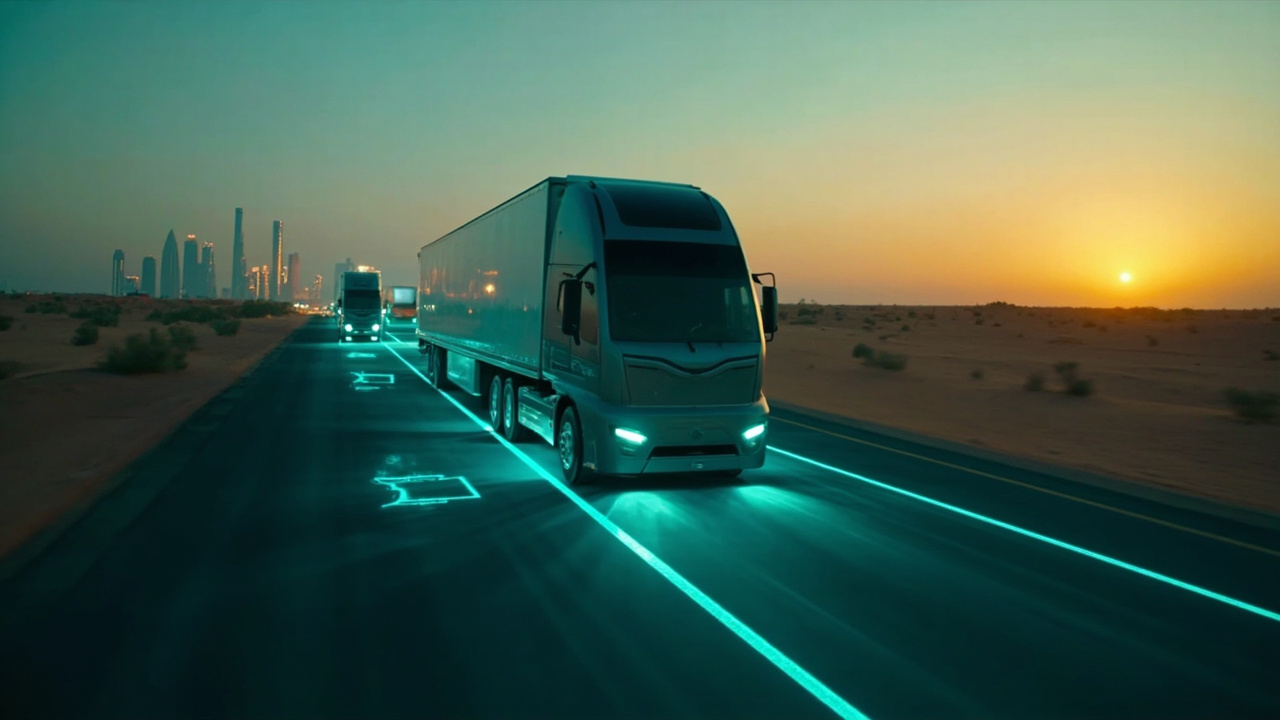
On August 31, 2026, Saudi Arabia’s national AI champion HUMAIN and Sunnyvale-based Applied Intuition announced a strategic collaboration to deploy physical AI across the Kingdom — starting with what the two companies describe as the largest autonomous trucking network in the world. Thousands of driverless trucks are planned to operate across key Saudi logistics corridors by 2030, with later phases expanding into robotaxis, ports, mining, manufacturing, agriculture, and construction.
What was announced
The deal, announced simultaneously from Riyadh and Sunnyvale, establishes a “foundational framework for autonomy at national scale.” It pairs HUMAIN’s sovereign AI infrastructure — gigawatt-scale data centers, cloud platforms, and Arabic large language models — with Applied Intuition’s end-to-end physical AI stack, delivered through a long-term commercial partnership rather than a pilot or a memorandum of understanding.
The scope is deliberately sequenced. Autonomous trucking comes first because it is, in the companies’ words, a “large-scale, tangible application where AI can have a direct impact on productivity, logistics, and economic growth.” Once the freight backbone is running, the same autonomy platform is intended to roll out across passenger robotaxis, port logistics, and heavy industry.
Applied Intuition has already established an office in Riyadh and is building a local engineering team to launch, operate, and scale the fleets — a signal that this is meant as a durable, in-country capability rather than an exported product with a support contract.
The technology foundation
The technical centerpiece is Applied Intuition’s Self-Driving System (SDS), which the company says is already operating Level 4 trucks on public roads in the United States, Europe, and Japan. SDS is paired with Vehicle OS, Applied Intuition’s vehicle software platform, and a multi-domain autonomy model designed to transfer across industries — the same underlying perception, planning, and vehicle-intelligence software intended for mining haul trucks, construction equipment, and agricultural machinery.
That multi-domain bet is what makes this collaboration notable beyond trucking. Most autonomous driving programs are vertical: a company builds a robotaxi stack, or a trucking stack, or a mining stack. Applied Intuition’s pitch is a horizontal platform — “built to scale across a billion moving machines” — where autonomy learned on highway freight corridors becomes the foundation for ports, farms, and construction sites. Saudi Arabia, with its concentrated freight corridors and centralized infrastructure investment, is arguably the ideal first customer for that thesis.
Why Saudi Arabia, and why now
Three conditions make the Kingdom an unusually good testbed for national-scale autonomy. First, geography: Saudi Arabia’s major freight corridors are long, well-maintained highways connecting ports, industrial cities, and population centers — the exact operating domain where Level 4 trucking is most tractable. Second, capital: HUMAIN is a PIF (Public Investment Fund) company with the resources to fund deployment at a scale no private logistics firm would attempt alone. Third, workforce: like many economies, Saudi commercial trucking faces persistent driver shortages, and autonomous fleets directly address that constraint while increasing fleet utilization — driverless trucks can run around the clock.
The partnership is also the first major initiative under HUMAIN’s physical AI strategy, which explicitly aims to extend AI “beyond the data center and into the physical systems that deliver real-world impact.” For a company whose visibility so far has come from data centers, chips, and Arabic LLMs, autonomous freight is the first visible proof point that sovereign AI investment translates into physical infrastructure.
What the executives said
“Autonomous trucking will change the economics of moving goods and people,” said Tareq Amin, CEO of HUMAIN. “Our goal with Applied Intuition is to make this region the first to deploy autonomous trucking at scale. Thousands of autonomous trucks operating around the clock can transform the speed, cost, and capacity of our logistics network, with a multiplier effect across economies. We have an opportunity to set a global benchmark for autonomous freight.”
Qasar Younis, co-founder and CEO of Applied Intuition, framed the deal in the context of his company’s stated mission: “Physical AI is the next frontier of intelligent infrastructure, and Saudi Arabia has the ambition to deploy it at unprecedented scale. Our vision with Applied Intuition is to bring intelligence to a billion machines around the world, and this is exactly the kind of national-scale deployment we built our platform to enable.”
Context: the autonomous trucking race
The announcement lands in an increasingly crowded autonomous trucking field. Applied Intuition itself has been quietly building credentials: a partnership with Isuzu that deployed second-generation autonomous trucks on a 450-kilometer commercial logistics route in Japan earlier in 2026, and a long-standing collaboration with Komatsu in mining autonomy. In the U.S., Aurora Innovation has been running driverless Class 8 trucks commercially in Texas, while Kodiak Robotics delivers autonomously for energy-sector customers. China has moved autonomous freight onto public roads at scale.
What differentiates the Saudi project is not the technology — Level 4 trucking is now proven — but the deployment model. Rather than incrementally adding autonomous lanes to an existing private fleet, HUMAIN and Applied Intuition are attempting to build a unified national autonomous logistics network from the top down, with state backing, in a single coordinated program. If it works, it would be the first country-scale reference case for physical AI as national infrastructure, and a template other Gulf and Asian states are likely to study closely.
What to watch
The 2030 target for “thousands” of trucks leaves ample room for phased milestones, so the near-term signals to watch are operational: which corridors get the first deployments, whether safety drivers are retained initially, how the vehicles are integrated with port and warehouse operations, and whether the promised robotaxi and mining phases follow on schedule. Applied Intuition’s Riyadh hiring is also worth tracking — the pace of local team building will indicate how serious the in-country commitment is.
For the broader industry, the collaboration is another data point in physical AI’s shift from venture-backed science projects to sovereign-backed infrastructure programs. The companies that win this phase will be the ones that can operate at national scale — and as of today, Saudi Arabia has placed one of the largest bets on the table.
Sources
- [1] https://www.appliedintuition.com/press-releases/applied-intuition-humain-physical-ai-saudi-arabia
- [2] https://www.bloomberg.com/news/articles/2026-08-31/saudi-ai-firm-humain-applied-intuition-partner-on-self-driving-trucks
- [3] https://www.appliedintuition.com/blog/isuzu-applied-intuition-autonomous-trucks-commercial-logistics-japan
- [4] https://www.cbnme.com/logistics-news/humain-brings-nvidia-drive-hyperion-autonomous-vehicle-platform-to-the-middle-east/