ByteDance's Lucida Turns Messy Room Videos Into Editable 3D Scenes for Robots
ByteDance Seed's Lucida pipeline parses cluttered indoor video into per-instance scene graphs, generates an asset per object, and lets a VLM policy drive the 3D editor's own gizmo handles until it decides placement is done — posting a 69% mAP gain on R2S-Scene.
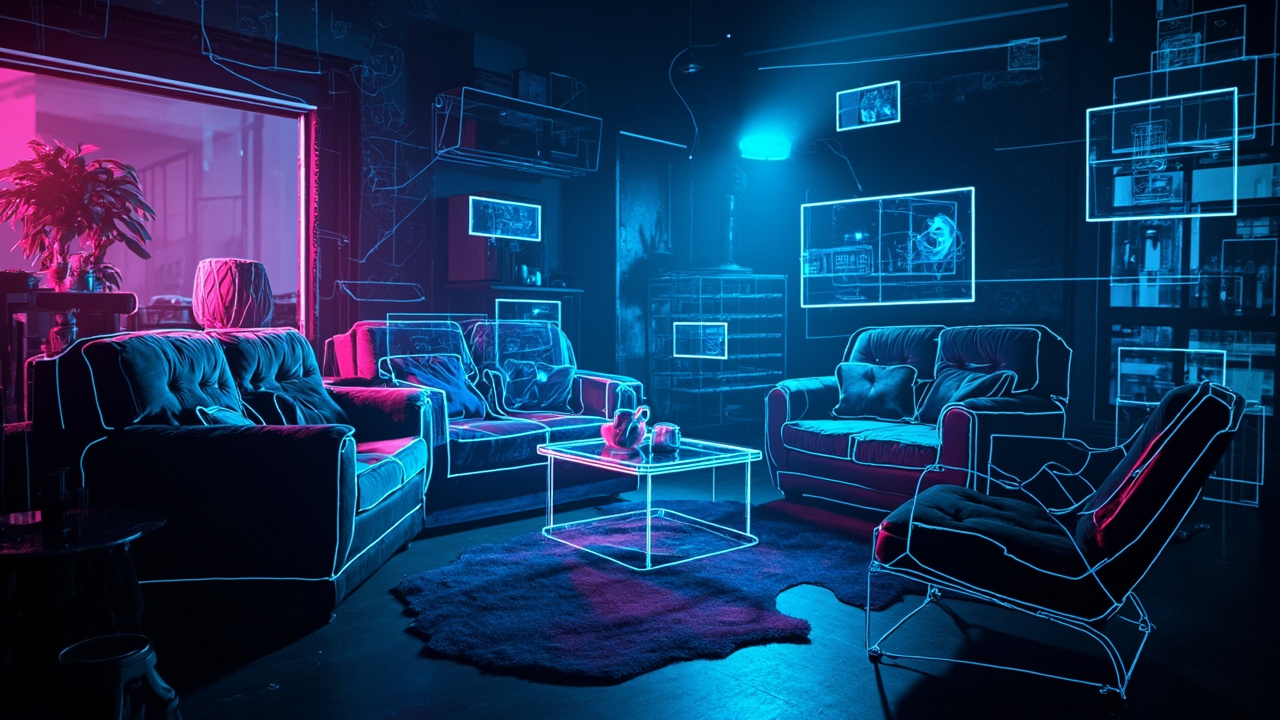
Every robotics lab faces the same unglamorous bottleneck: you can train a manipulation policy in simulation forever, but the simulator still needs a faithful copy of the room the robot will actually work in. On August 31, ByteDance’s Seed team published a paper that takes a serious swing at that problem. Lucida — listed as arXiv 2608.30821 and already trending on Hugging Face’s Daily Papers with 40 upvotes in its first hours — takes ordinary video of a cluttered indoor scene and hands back a simulation-ready replica in which every object is a separate, editable asset, placed where the camera actually saw it.
The problem: pipelines that demand perfection upfront
Composable scene modeling — recovering a real room as complete, individually manipulable object assets arranged as observed — matters because embodied AI and robot simulation need digital twins of real environments. The existing recipe decomposes the task into three steps: parse the observations into instances, generate a 3D asset for each instance, and place each asset back into the scene.
The Lucida authors’ core observation is that this order silently assumes things a real capture almost never provides. Parsing assumes accurate instance geometry. Generation assumes unoccluded views of each object. Placement assumes assets that already match the observations. Walk into any real living room with a phone camera and none of those assumptions survives contact: chairs are half-hidden behind tables, lamps are visible only from one side, and no asset library contains the exact dented mug on the desk.
Lucida’s answer is architectural rather than magical. It keeps the parse-generate-place order but “redistributes the requirements, so each step consumes only what a real capture reliably provides and precision is reached at the end of the pipeline rather than demanded at its start.”
Inside the pipeline
Three stages carry the design:
1. Parsing into evidence-carrying scene graphs. Lucida parses the input video into a scene graph whose nodes carry per-instance multi-view evidence — partial observations accumulated across frames rather than a single perfect reconstruction of each object.
2. Per-instance asset generation. For each node, the system generates a complete asset from that instance’s multi-view evidence. Because generation consumes accumulated evidence instead of demanding a clean, unoccluded scan, a half-visible armchair still yields a full armchair asset.
3. Placement by GUI manipulation — GizmoAct. This is the paper’s most unusual idea. Placement is handled by GizmoAct, a vision-language-model policy that casts asset placement as multi-turn GUI interaction: it manipulates the object’s transform gizmo — the same position/rotation handles a human 3D artist drags in Blender or Unity — in a closed loop, and decides for itself when alignment is reached. No differentiable placement loss, no hand-tuned Iterative Closest Point registration; a VLM looks at the editor viewport, nudges the handles, looks again, and calls it done.
That last stage deserves emphasis. Casting a geometric estimation problem as closed-loop GUI operation is the same conceptual move that made general-purpose computer-use agents viable: instead of building a specialized solver, point a multimodal model at the interface humans already use and let perception drive action. Lucida’s contribution is showing that this trick survives contact with 6-DoF placement — traditionally among the most precision-hungry tasks in 3D vision.
The numbers
On three standard evaluation surfaces, the paper reports:
| Metric | Baseline | Lucida |
|---|---|---|
| Scene-level 3D detection mAP (R2S-Scene) | Boxer | +69% improvement |
| ADD-SB@0.05 pose estimation (CA-1M) | 57.8% | 83.4% |
| Scene F-Score (reconstruction) | 0.794 (SAM3D) | 0.924 |
The pose-estimation jump is the headline: lifting ADD-SB@0.05 from 57.8% to 83.4% on CA-1M means the placed assets align with where objects actually appeared in the overwhelming majority of cases, not merely most of them. A scene F-Score of 0.924 versus SAM3D’s 0.794 similarly indicates reconstructions that are both complete and precise.
Caveats worth stating plainly: per-instance and per-category breakdowns are absent from the abstract, and this is a preprint rather than a peer-reviewed result. All numbers are author-reported. The upvote velocity on Hugging Face — 40 within hours of appearing on Daily Papers — signals community interest, not validation.
Why this matters beyond the benchmarks
The practical prize is the robot-training loop. Digital-twin pipelines that require clean captures from a laboratory turntable don’t scale to warehouses, kitchens, or homes. A pipeline that accepts messy handheld video and outputs editable, composable assets directly attacks the sim-to-real gap at its source: the fidelity of the simulator itself. ByteDance Seed has an obvious institutional interest here — the group also ships manipulation research such as its “manipulation as in simulation” suite — and Lucida slots cleanly into that stack as the scene-acquisition front end.
The deeper signal is methodological. Lucida joins a growing list of 2026 systems that replace brittle geometric machinery with VLM judgment inside a feedback loop — and it extends that pattern from 2D screens into 3D viewports. If closed-loop GUI operation proves robust for gizmo manipulation, the same template plausibly extends to rigging, physics-parameter tuning, and other editor tasks where the objective is easy to see and hard to specify. For anyone building production real-to-sim capture, the paper’s editor’s-note takeaway is worth pinning to the wall: push precision to the end of the pipeline, and let each stage consume only what real captures actually give you.
The paper is authored by Minghan Qin, Yuang Wang, Xiuyu Yang, Yushi Long, Yujian Zhang, Ruihuan Wang, Kai Ye, Yangang Zhang, and Hang Li, with a project page at lucida-r2s.github.io.