Google and Khan Academy Ship Gemini-Powered Classroom AI: Interactive Diagrams and Teacher-Controlled Practice
Khanmigo can now generate interactive math and science diagrams that respond as students drag and explore, while a rebuilt Practice My Knowledge tool keeps teachers in charge of every AI-drafted question.
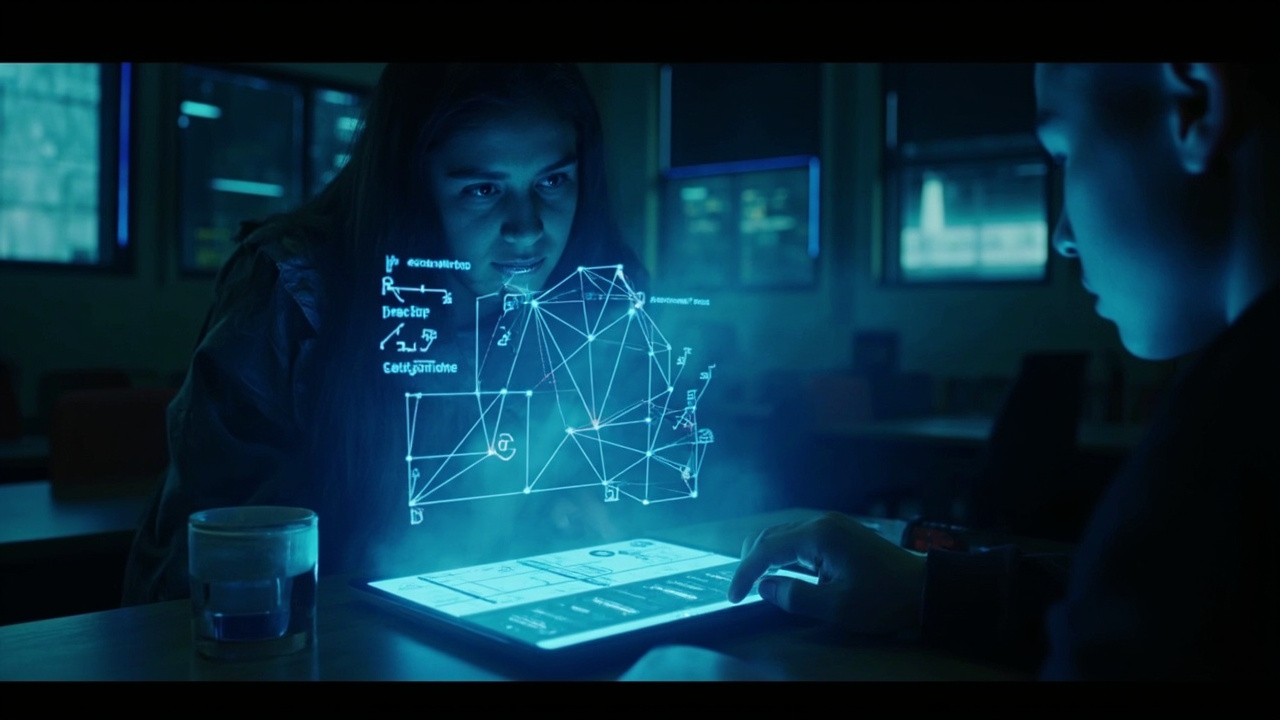
Just in time for the 2026 back-to-school season, Khan Academy and Google have rolled out the first substantial upgrade to come out of their AI partnership: two new Khanmigo features built with Google’s Gemini models that change how the AI tutor communicates with students — and how much control teachers have over what lands in front of them.
The announcement, published August 27, 2026 on both the Khan Academy and Google blogs, marks the moment the partnership moves from early pilots to real classrooms. It is also one of the clearest examples yet of a major AI company embedding its frontier models into a widely used nonprofit education platform — with Google engineers working inside Khan Academy for six months to make it happen.
What’s new: from text-only tutor to interactive visuals
The headline feature is interactive diagrams. Until now, Khanmigo — Khan Academy’s AI tutor and teaching assistant — could only respond to students in text. That has been a persistent complaint about AI tutors in general: they explain concepts in words when many students would understand faster by seeing the idea drawn out.
With Gemini’s reasoning capabilities integrated, Khanmigo can now detect the moment when a visual would actually help a student and generate an interactive diagram on the spot: charts, geometric shapes, parallel coordinate plots, and more. Crucially, these are not static images. If a student drags a vertex or moves a line segment in a graph, Khanmigo recognizes the change and adapts the lesson accordingly. The tutor responds to what the student is physically doing with the diagram, rather than just narrating next to a picture.
Building this well took more than wiring a model to a canvas. Google engineers first helped define the underlying metrics for what makes a high-quality diagram, then evaluated generated visuals for relevance, helpfulness, and clarity — so that diagrams appear precisely when students can benefit most, not as decoration. The teams also refined visual details like labeling and built a new feedback widget directly into Khanmigo so real user input can keep improving the experience.
The teacher side: Practice My Knowledge rebuilt
The second feature targets teachers, and its design philosophy is the most telling part of the whole release. Khan Academy’s Practice My Knowledge tool previously did one thing: generate multiple-choice practice questions with AI. Teachers had no way to curate what was sent to students.
The rebuilt version, with Gemini integrated directly, turns that into a full teacher-controlled workflow. Teachers can now partner with Gemini to plan, draft, and validate practice questions — in seconds, according to Khan Academy — before any student sees them. They can upload their own materials for Gemini to reference, keeping questions anchored to what was actually taught. Before an assignment goes out, the teacher reviews the full set, editing or rejecting any question. Once students complete the work, teachers receive structured performance reports showing where students are doing well and where they need support, with assignments that can be scored or unscored.
The principle is stated plainly: Gemini drafts the materials, but teachers have the final say on what students see. Teachers and administrators have told Khan Academy that these controls let them ensure questions are at the right difficulty level for their students — the kind of contextual judgment no model can substitute for.
The partnership behind it: six engineers, six months
The technical work came out of a Google.org Fellowship: since March 2026, a team of six Google engineers worked embedded alongside Khan Academy’s product and engineering organization. The partnership also included a Google.org grant and gave Khan Academy’s experts direct access to Gemini models in time for the 2026 school year.
“Google is a tremendous partner,” said Sal Khan, founder and CEO of Khan Academy. “The Google.org Fellows have supercharged our engineering effort, allowing us to produce several new AI-powered features in time for students and teachers to use these tools in the new school year.”
Jen Carter, head of technology at Google.org, framed it as a division of labor: “By combining their deep expertise in student learning with Google’s AI engineering, we are empowering teachers and students with tools designed to make learning more effective, engaging, and accessible than ever before.”
Early signals on learning outcomes
Khan Academy is careful to call the evidence preliminary, but the early data points are worth noting. The organization reports initial signs of increased student engagement, and — more concretely — improvement in “next-item correctness”: a measure of whether a student correctly answers the very next problem on the same skill during the same session, without any help from Khanmigo. That is a stricter test than session time or satisfaction, because it checks whether the diagram actually transferred understanding to an unaided task immediately afterward.
Notably, this comes alongside other recent research attention on Khan Academy: an August 2026 randomized trial of Khan Academy in math intervention has been circulating in education-research circles, suggesting the platform itself is under growing pressure to show evidence, not just adoption.
Why it matters
Two things make this release more significant than a routine feature launch.
First, it is a working template for human-in-the-loop classroom AI. The loudest concern about AI in education — from teachers, unions, and parents alike — has been that generative models will produce coursework or answers unsupervised. Practice My Knowledge is built as the structural opposite: the AI never publishes anything a teacher hasn’t reviewed. If that pattern proves durable, it is a credible answer to the trust problem that has slowed AI adoption in schools.
Second, it signals where AI tutoring is heading: multimodal and interactive rather than conversational. Text-only tutoring was step one. Diagrams that react to a student’s own manipulations — dragging a vertex and watching the lesson adapt — point toward AI tutors that operate on shared visual objects, closer to how a human tutor sketches on paper with a student. It also extends Google’s education footprint: Gemini is now inside one of the most widely used nonprofit learning platforms, weeks before Apple is expected to unveil its rebuilt, Gemini-powered Siri on September 9 — a reminder that Google’s models are reaching users through far more channels than its own products.
For district leaders, the pitch is deliberately conservative: tools that are useful, easy to adopt, and part of a proven learning platform. The new features are available to Khanmigo districts now. Whether interactive diagrams measurably move learning outcomes at scale remains to be seen — but the combination of Gemini’s generation capability with teacher-gated deployment makes this one of the most thoughtfully designed AI-in-education rollouts of the school year.
Sources
- [1] https://blog.khanacademy.org/new-ai-tools-bring-interactive-diagrams-and-targeted-practice-thanks-to-khan-academys-partnership-with-google-org/
- [2] https://blog.google/products-and-platforms/products/education/khan-academy-back-to-school/
- [3] https://www.edtechinnovationhub.com/news/khan-academy-brings-gemini-powered-visual-tutoring-into-classrooms-for-2026