Drinking Water Beside an Ocean: Terence Tao Warns That Good Math Problems Are Now a Non-Renewable Resource
Hours after OpenAI's contested Navier–Stokes announcement, Fields Medalist Terence Tao laid out the deeper worry in a four-part essay: without boundaries on AI solution-mining, the field's scarce resource is not answers but good questions — and the incentives now point toward secrecy.
On September 8, 2026, while the mathematics world was still digesting OpenAI’s contested Navier–Stokes announcement and the priority dispute with NYU’s Tristan Buckmaster, Terence Tao posted something quieter — and arguably more consequential. In a four-part thread on Mathstodon, the UCLA Fields Medalist extended his warning from the previous week into a full economic argument: the scarce resource in mathematics is not solutions. It is good problems. And that resource, he argues, is now being mined in a non-renewable fashion.
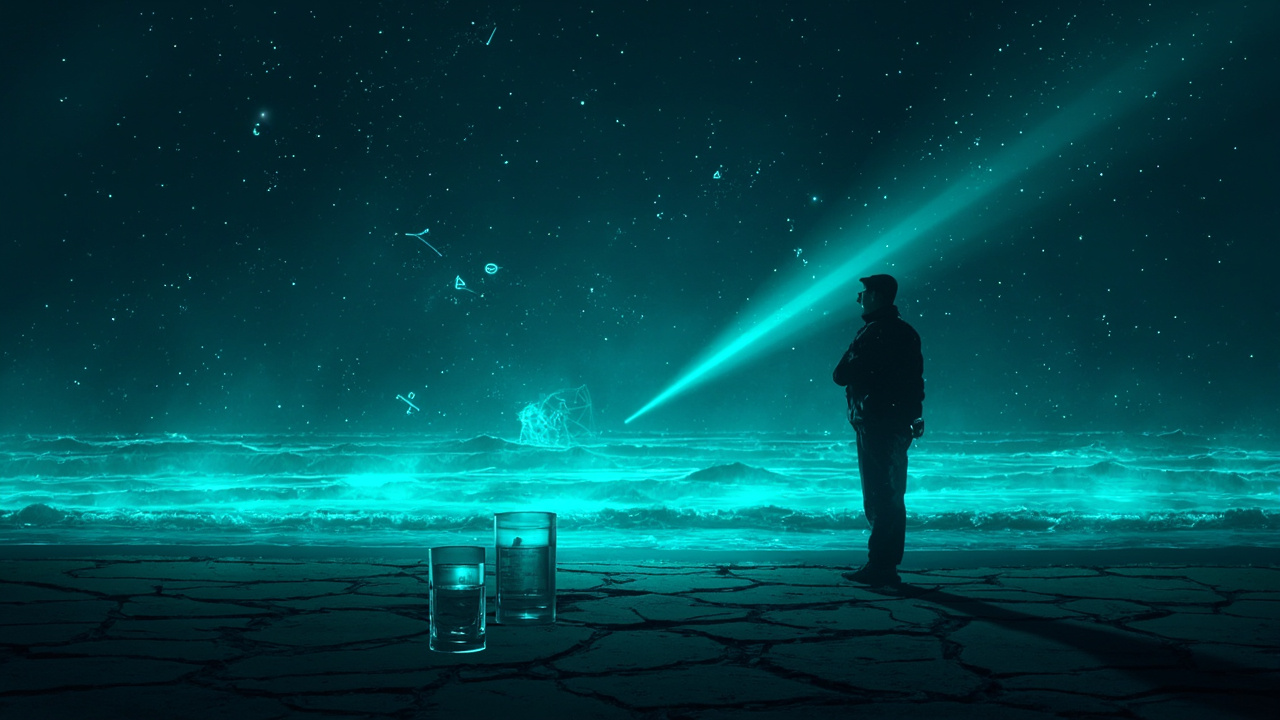
His opening image is the one that will be quoted for years: a country can suffer “a critical shortage of drinking water while simultaneously being surrounded by a massive ocean.” Yes, the set of possible mathematical questions is infinite — anyone can generate open problems at will, like asking for the 10^10^10th digit of pi. But the vast majority of them are not worth anyone’s attention: they show no propensity to reveal insights, no connections to other questions. What makes a problem good is exactly what makes it scarce.
Why a solved problem can be worse than an unsolved one
Tao’s thread is the fourth installment in a line of argument he has been building all month. On September 3 he made the counterintuitive case head-on: “It seems intuitive that a solved problem is unquestionably better than an unsolved problem: a magic button which, when pressed, turns the…” — and then dismantled the intuition. Answering a question can carry irreversible costs, the way a spoiler permanently diminishes a first viewing of a film, or a leak damages the fairness of a competition.
The Navier–Stokes regularity problem is his worked example, and his treatment of it is deliberately deflating. The value of the problem, he argues, was never the physical payoff — computational fluid dynamics is mature, and a regularity theorem would not change how anyone models weather or climate. The value was everything the attempts generated: Leray–Hopf weak solutions, the Gagliardo–Nirenberg–Ladyzhenskaya inequalities, partial regularity theory, the Beale–Kato–Majda blowup criterion, and Tao’s own fluid-computation and Turing-universality program with its unexpected links to symplectic topology.
He even sketches what a legitimate machine-assisted resolution might look like: a nearly self-similar ansatz, a numerical near-solution with a tiny computable residual, a stability argument perturbing it into an exact one — a heroic combination of ML-powered simulation, interval arithmetic, formalization, and LLM-proposed ansätze, steered by human experts, with a Lean verification that would rank among the largest proof artifacts ever created. And then the crucial caveat: the instructive part only works “if the iterator did not have access to the final ansatz in advance,” because foreknowledge suppresses the dead ends where the insight actually lives.
The failure mode he now considers realistic is precisely what the week delivered: an autonomous harness with vast compute running the entire iteration internally, the process kept out of public view, and one of the most prominent open problems in mathematics technically solved with “almost no value added to mathematics as a consequence.”
What the week actually looked like
Tao’s posts came at the end of a seven-day stretch that reads like a stress test of every norm the field has. On September 3, he noted “the unedifying spectacle” of three separate AI companies racing to announce improvements to the Polymath8 bound on prime gaps via social media. On September 5, he proposed — half in earnest — a new competition for AI companies: race to be first to announce a new mathematical insight rather than a new solution. On September 7, he drew on Section 14.1 of the Equational Theories Project report to document the opportunity costs of moving too fast.
Then September 8 brought the deluge: Buckmaster and Levent Alpöge’s blowup results for porous medium, Boussinesq, and 3D Euler equations; OpenAI’s announcement of a model-generated forced Navier–Stokes proof; and, by what Tao called “sheer coincidence,” a third independent result — a PINN-based candidate for a stable Euler singularity from the group of Gowri Ganeshram, Vincente Duruisseaux, and Anima Anandkumar at Caltech.
Tao’s response to the human-AI work is notably warm. He calls Alpöge–Buckmaster “a remarkable achievement,” appreciates that the authors spent weeks reworking the AI-heavy arguments into acceptable form, and admits that Buckmaster explaining the key ideas to him by telephone was “a refreshing change from AI-based communication modalities.” He sees nothing in principle preventing their methods from reaching Navier–Stokes, and a non-negligible chance the forcing term could be eliminated entirely — though he adds, in the most Tao sentence of the whole affair, that he would not be surprised if one could “batter out such an extension by pouring an enormous amount of compute and AI assistance” at it, but “such an exercise does not particularly hold my interest.”
The part about secrecy should scare scientists most
The third installment of the thread is the one with the widest implications outside mathematics. The difficulty landscape of a field — knowing which questions are easy, which take effort, which are impossible — is how researchers locate promising problems and how the profession trains its judgment. AI tools are now flattening that landscape in many areas at once. Normally, Tao notes, this is counteracted by the tool enlarging the sphere of results one can plausibly reach, creating new frontiers to explore.
But not this time, for two reasons. The technology is moving too fast for stable boundaries to form. And — his blunter charge — the situation is “compounded by the refusal of AI companies to disclose their negative results, or reveal the process towards obtaining their solutions.” Without knowing where models failed, the community cannot map where the AI-hard territory begins.
The consequence is an inversion of value: “It is now the identification of a promising problem which is the scarce and precious resource.” And then the sentence that should be read by every research-funding body on Earth: “We have now seen that even the rumor of someone working on a problem can trigger a massive amount of AI-powered effort to flatten it before the original research project has time to reach its full potential.” The Buckmaster affair is the case study — OpenAI has confirmed it began its Navier–Stokes effort after hearing rumors of an outside breakthrough. Tao’s conclusion: the incentives now point toward no longer sharing promising research directions with the community, “which would reverse centuries of traditions of open science and do serious long-term damage to the future of the field.”
What he proposes instead
Tao does not call for prohibition, which he considers technically infeasible. His closing proposal is subtler and more actionable: the community should designate classes of problems as wanting a careful analysis that not only solves the problem but identifies insights from the solution process and maps the difficulty landscape of nearby problems — and for these, raw solutions without such analysis “would be of negligible or even negative value.” His analogy is a modern food drive, which no longer accepts any technically edible donation but publishes explicit standards for what contributions are actually sought.
It is a governance answer to a governance problem: you cannot stop the mining, but you can change what counts as a contribution. Whether social pressure of the kind that discourages movie-spoilers can scale to an industry where a single proof announcement moves markets, valuations, and a $22.5 million compute bill — as Gary Marcus noted in his summary of Tao’s warnings — is the open question the field now has to solve about itself.
The irony is not lost on anyone involved: mathematics may have just gained a solution to one of its seven Millennium Problems while discovering it has a much more urgent problem of its own.
Sources
- [1] https://mathstodon.xyz/@tao/117237320796901560
- [2] https://teorth.github.io/tao-web/ai-views.html
- [3] https://garymarcus.substack.com/p/two-dire-warnings-one-from-terence
- [4] https://mathstodon.xyz/@tao/117207856734787448
- [5] https://www.quantamagazine.org/why-the-legendary-erdos-problems-are-falling-to-ai-20260803/