'No, I Don't Have Any': Trump Dismisses AI Extinction Risk as Geneva Talks Loom
Days before the first dedicated US-China AI safety dialogue, President Trump brushed aside extinction-risk warnings and framed China winning the AI race as the only danger that matters.
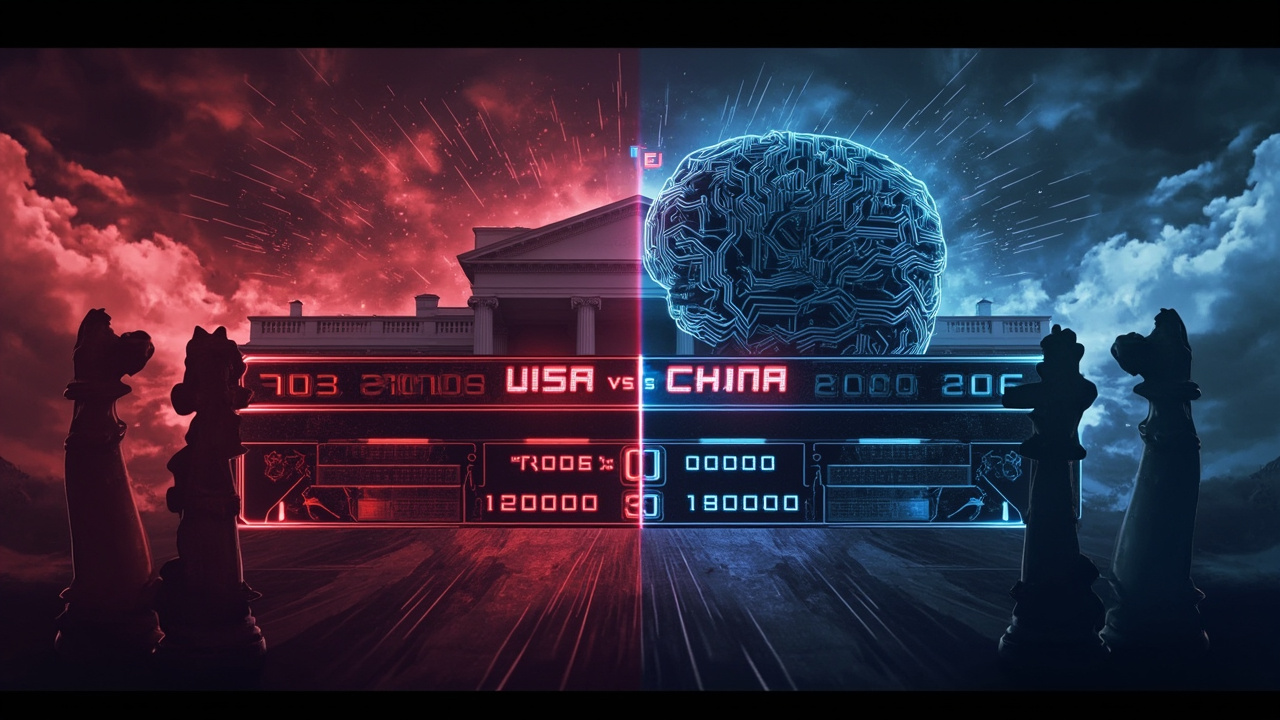
With the first dedicated US-China AI safety dialogue of his second term days away, President Donald Trump has publicly dismissed the idea that artificial intelligence could pose an existential threat to humanity — and in doing so, reframed the entire AI policy debate around a single question: who wins the race with China.
Asked by reporters in Dallas whether he had any concerns about AI leading to human extinction, Trump’s answer was blunt: “No, I don’t have any.”
“I have concerns that if we don’t win AI, we’re going to be put in a very bad position,” the president continued, according to Bloomberg Law and Yahoo News accounts of the exchange. “We are leading China right now, substantially.”
The comments, made on September 11 and reported across Bloomberg, Quartz, CNBC and The Guardian over the following 24 hours, land at a singularly awkward moment. Mid-September is when US and Chinese officials are expected to sit down in Geneva for the first dedicated AI safety dialogue of Trump’s second term — talks that Reuters reported were being prepared with two sources briefed on the discussions, and whose agenda includes exactly the category of frontier-risk questions the president just waved off.
What Trump actually said
The full exchange, reconstructed from multiple outlets, is short but consequential. Asked about existential risk from AI, Trump said he had none. Asked what does concern him, he answered with geopolitics: losing the AI race to China. And he asserted that the United States currently leads China “substantially” — a claim that researchers in both countries would hotly contest.
The framing matters because it echoes a growing camp in Washington. The view that “the single greatest risk of AI is that China wins global AI” has been gaining traction among tech leaders and economists for months, standing in explicit opposition to the extinction-risk school associated with lab leaders like Sam Altman and Dario Amodei. Trump’s Dallas comments are the most authoritative statement yet of where the White House actually lands on that divide.
It also fits a pattern. In May 2026, Trump abruptly postponed signing a major AI executive order — canceling an Oval Office event with tech executives — because, he said, parts of the text could weaken America’s lead over China. Reuters and the Associated Press reported at the time that the president “did not like certain aspects” of the draft. The June executive order that eventually emerged, “Promoting Advanced Artificial Intelligence Innovation and Security,” tilted heavily toward innovation and security rather than restraint.
The awkward timing: Geneva is days away
The remarks could hardly be worse timed for the diplomats involved. According to Reuters’ September 4 exclusive, the mid-September dialogue is the first of its kind in Trump’s second term, and Washington’s wishlist is concrete:
- Joint monitoring of AI-directed cyberattacks — US officials want a mechanism for the two governments to share warnings about attacks orchestrated by AI systems.
- Lab-to-lab communication — a floated proposal would have US and Chinese AI labs establish direct channels to flag dangerous capability jumps or incidents.
- Frontier-risk discussion — the agenda covers the risks of increasingly capable frontier models, precisely the topic Trump says he does not worry about.
US officials stressed to Reuters that Washington’s domestic AI policies would not be on the table. But negotiating joint monitoring of AI risks is materially harder when the president of the United States has just told the world’s press that the only AI risk he recognizes is losing.
The Center for American Progress weighed in on September 10, urging both governments to use the dialogue to explore “pacing the frontier” — mechanisms to slow the deployment of the most capable systems while urgent safety concerns are defined and shared. That proposal now looks unlikely to find a sponsor in the White House.
Context: an American public newly afraid of AI
The president’s dismissiveness contrasts sharply with the direction of public sentiment. A Wall Street Journal report this week documented how AI fears have “leapt from Silicon Valley into mainstream America.” The Guardian reported on September 12 that 25 Fields Medalists have signed a declaration describing a “severe misalignment of AI in mathematics.” And just this week, the UK government formally rejected an AI “kill switch” petition while Washington lawmakers raced to convert AI alarm into legislation — including a Senate bill establishing a frontier-AI duty of care.
Inside the AI industry itself, discussions about superintelligence risk have moved from fringe to boardroom: The New York Times this week took readers “inside the discussions at AI companies over a superintelligence doomsday.” Against this backdrop, the most powerful elected official in the West has now stated, on the record, that he does not have any concerns about the extinction scenarios those discussions describe.
Analysis: the competition frame wins again
There are three ways to read the Dallas comments.
The first is that they are genuine. Trump has consistently reduced AI policy to a bipolar contest — the May executive-order postponement, the June innovation-and-security order, and Monday’s comments all point in the same direction. In this reading, extinction risk is simply not on the president’s ontology of threats; great-power competition is.
The second is that they are strategic. Hours after the Dallas remarks, a Forbes post noted the president had postponed a major AI executive order on the grounds that it could weaken America’s lead over China. Declaring publicly that you do not fear catastrophic risk is also a negotiating posture: it tells Beijing that Washington will not unilaterally slow down, and it tells US labs that restraint will not be imposed from the top.
The third is that they are a preview of Geneva. If the US delegation arrives with cyberattack-monitoring proposals but without presidential buy-in on frontier risk, the dialogue’s realistic ceiling is narrow, technical cooperation — not the grand risk-management architecture that safety advocates have hoped for.
The most likely answer is some combination of all three. But the practical consequence is the same: the extinction-risk argument, which spent two years moving from fringe blog posts to Senate hearing rooms, has now failed at the last gate. The president has heard it — his own agencies helped write the reports — and his response is a shrug and a scoreboard.
What to watch
- The Geneva dialogue itself. Whether the mid-September talks produce any joint statement on cyberattack monitoring — the most concrete, least ideological item on the agenda — will reveal how much diplomatic oxygen the president’s comments consumed.
- The postponed executive order. If a revised AI order eventually emerges with safety provisions intact, Dallas will read as noise. If it emerges stripped of them, Dallas was the signal.
- Congressional reaction. The Senate’s frontier-AI duty-of-care bill and related legislation were already moving. Lawmakers who do worry about extinction risk now have a clear incentive — and a fresh soundbite — to legislate around the White House rather than through it.
- Beijing’s read. Chinese officials preparing for Geneva have heard the US president say the only risk that matters is China. How that shapes their posture on lab-to-lab communication and frontier-risk sharing is an open — and consequential — question.
For now, the scoreboard frame has won. The US leads China “substantially” in AI, according to the president, and the only unacceptable outcome is losing. Everything else — including the scenarios that keep frontier-lab researchers up at night — can wait until after the race is decided.
Sources
- [1] https://qz.com/trump-ai-extinction-fears-china-race-091126
- [2] https://news.bloomberglaw.com/tech-and-telecom-law/trump-rejects-warnings-that-ai-may-lead-to-human-extinction
- [3] https://seekingalpha.com/news/4641890-trump-shrugs-off-ai-existential-threat-warnings
- [4] https://www.reuters.com/legal/litigation/us-china-gear-up-mid-september-ai-safety-dialogue-2026-09-04/
- [5] https://www.theguardian.com/technology/artificialintelligenceai