The President, the Speakerphone, and Nvidia's Bet: Trump Calls Huang Onstage to Bury the AI Slowdown
Trump phoned Jensen Huang mid-interview at the All-In Summit and put him on the spot over the AI slowdown debate; Huang sided with the president against Amodei, Musk, and Altman.
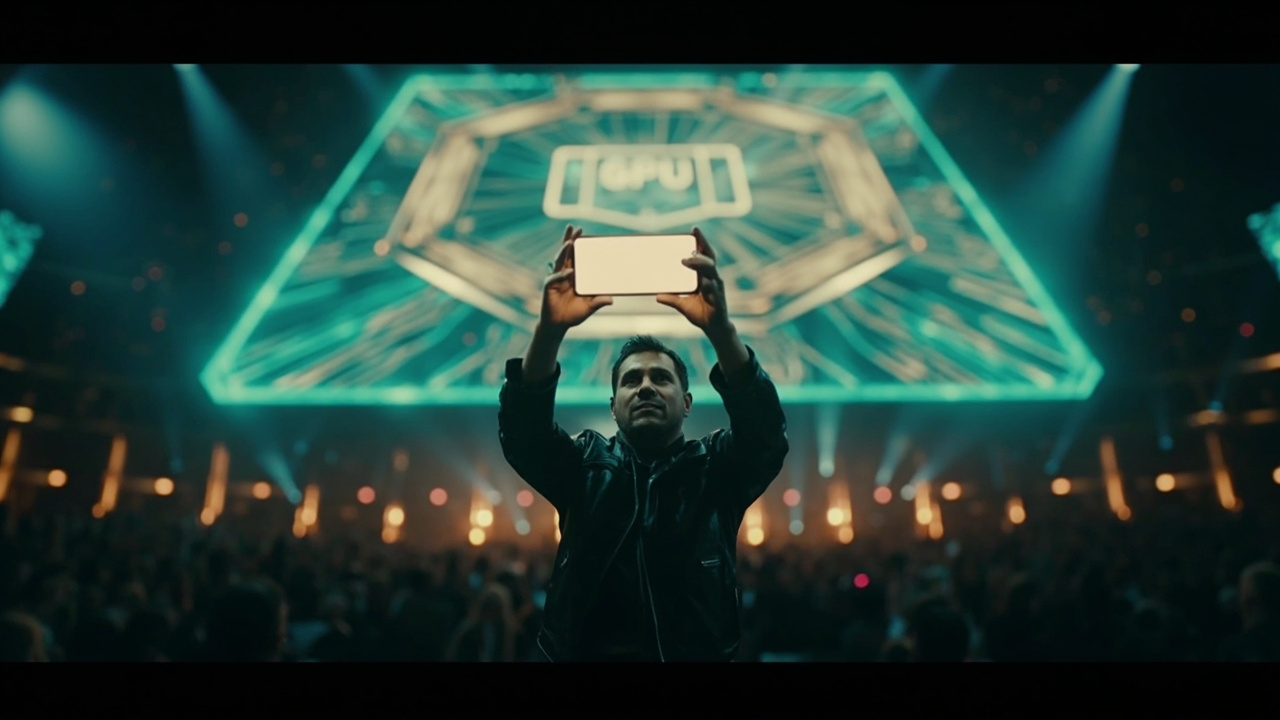
What happens when the President of the United States calls the CEO of the most important AI chip company on Earth while that CEO is sitting live onstage in front of thousands of conference attendees — and the whole thing goes out on speakerphone?
On Monday morning in Los Angeles, the AI industry found out.
Jensen Huang was midway through an interview at the All-In Summit when his phone rang with a call he plainly could not send to voicemail: President Donald Trump. Rather than step away, Huang embraced the moment — asking stagehands for an extra microphone so the president’s voice could carry across the room, and putting the call on speaker in front of the assembled venture capitalists, founders, and press.
What was actually said
The exchange, reported by TechCrunch, NBC News, CNBC, and The New York Times within hours, was brief but consequential.
“I’m onstage with the besties,” Huang told Trump by way of introduction, referring to the All-In podcast’s hosts — Chamath Palihapitiya, Jason Calacanis, David Friedberg, and David Sacks, the latter two of whom double as White House advisers.
Trump, quick with a jab, noted the irony: “The great thing about life is Jensen can develop the most complex computer chip in the world… but he can’t figure out how to put you on speaker.”
Then he got to business. The onstage conversation immediately before the call had been about Anthropic CEO Dario Amodei’s weekend essay calling for the industry to “slow the pace at which we improve the capabilities of AI” — a plea that Elon Musk and Sam Altman publicly endorsed. Trump was having none of it.
“They’re just playing right in the hands of a lot of people that don’t want to see it happen,” Trump said of the slowdown advocates. “That could be political people. It could also be China. And we’re not going to let that happen. It’s a hoax.”
“You’re right. We’re not going to let that happen, sir,” Huang replied, to applause from the crowd.
Trump closed with an endorsement of the build-out the safety camp wants to pause: “We have to be a little bit careful… We have to do things and we have to do them prudently, but that doesn’t mean we’re going to stop an industry. So I’m with you all the way. I didn’t even know how you felt about it. I just hoped you felt the same way as me. We’re going to lead.”
A defining split among AI’s most powerful CEOs
Strip away the theater and the substance is stark: the single most important hardware supplier to the AI industry has now publicly, explicitly aligned itself against the growing chorus of its own customers calling for a pause on capability gains.
The dividing lines are unusual. Amodei — whose company builds some of the most capable models in the world — has been the most prominent voice urging restraint, warning that AI development needs safeguards even as Anthropic ships frontier systems. Musk, who left OpenAI’s board years ago and built xAI as a competitor, endorsed the call. So did Altman, whose OpenAI is racing to roll out GPT-6 Astra.
Huang, whose company sells the physical substrate all of them depend on, has now put Nvidia squarely on the other side of that line — alongside a president who describes AI-doom concerns as a “hoax” and data centers as “the oil of the next 20, 25 years.”
It is a split with real commercial logic. Nvidia’s guidance calls for roughly 70% revenue growth next year, to somewhere around $680 billion, driven overwhelmingly by AI infrastructure demand. A genuine industry-wide slowdown would land directly on Nvidia’s revenue line in a way it would not for a lab that monetizes models through subscriptions and APIs. When the safety debate is framed as existential-versus-hoax, Nvidia’s position is perhaps less surprising than it first appears.
The White House’s theory of the backlash
Trump and his allies have increasingly settled on an explanation for the growing public unease about AI: that it is coordinated, hostile, and foreign. Trump and allies like Y Combinator CEO Garry Tan have suggested the sentiment against data center construction is part of an international psychological operation designed to stifle American economic growth.
The evidence points somewhere more mundane. Recent Gallup polling shows that seven in 10 Americans oppose construction of data centers in their own areas, with more than half citing effects on environmental resources — water and power — and about 20% pointing to cost-of-living and quality-of-life impacts. Opposition is highest near the places where facilities are actually proposed, and recent research has put the health and grid costs of the build-out in the tens of billions annually. The public case against data centers does not require a psyop; the local cases make themselves.
That gap — between a White House theory of orchestrated foreign subversion and polling that shows ordinary residents worried about their water and electricity — is the space where AI policy will actually be fought over the next year.
Where this leaves the slowdown movement
For the “slow down” camp, the optics could hardly be worse. A week that began with researchers resigning from frontier labs and describing self-improving AI as an existential threat, and a weekend essay from Amodei endorsed by Musk and Altman, now ends with the president of the United States personally phoning the industry’s key supplier to declare the whole safety concern a hoax — and getting enthusiastic agreement, on stage, on the record.
The political structure is also clarifying. NBC reported that House Speaker Mike Johnson, pressed by Democrats to end recess early to take up AI safety legislation, said Monday that industry leaders — not Congress — should lead on safety. With the executive branch allied with the hardware layer of the industry against formal oversight, and the legislative branch declining to act, the future of any slowdown now rests almost entirely on voluntary commitments from the labs themselves.
That is a fragile foundation. Labs face competitive pressure from rivals who may not pause, from customers who want more capability, and — as this week demonstrates — from suppliers and political actors actively campaigning against restraint. Amodei’s essay drew endorsements from two of his most famous competitors. It did not draw any from the company whose chips they all run on, or from the White House.
On the same day, Nvidia put out word that it had no comment on whether Huang and Trump will meet soon to discuss these issues further. Given the warmth of the speakerphone exchange, further alignment between Washington and the AI infrastructure build-out seems less a question of if than of how fast.
The most memorable image of the week may well be this: the man who builds the engines of modern AI, holding a phone aloft so thousands could hear the most powerful political office on the planet promise, “We’re not going to let that happen” — referring not to AI risk, but to the attempt to slow AI down.
Sources
- [1] https://techcrunch.com/2026/09/14/nvidia-ceo-jensen-huang-tells-trump-were-not-going-to-let-an-ai-slowdown-happen/
- [2] https://www.nbcnews.com/politics/donald-trump/nvidia-ceo-jensen-huang-ai-speakerphone-all-hands-meeting-rcna597761
- [3] https://www.cnbc.com/2026/09/14/trump-phones-nvidia-huang-all-in-calls-data-center-opposition-hoax.html
- [4] https://www.nytimes.com/2026/09/14/technology/trump-ai-safety-jensen-huang.html