A Clear and Present Danger: AI-Guided Malicious Drones Overwhelm Detection, Police Executives Warn
PERF's new report reveals 2,800 NFL stadium drone incursions and 23,000 illicit NYC flights a month — as AI-guided and fiber-optic drones render traditional countermeasures useless.
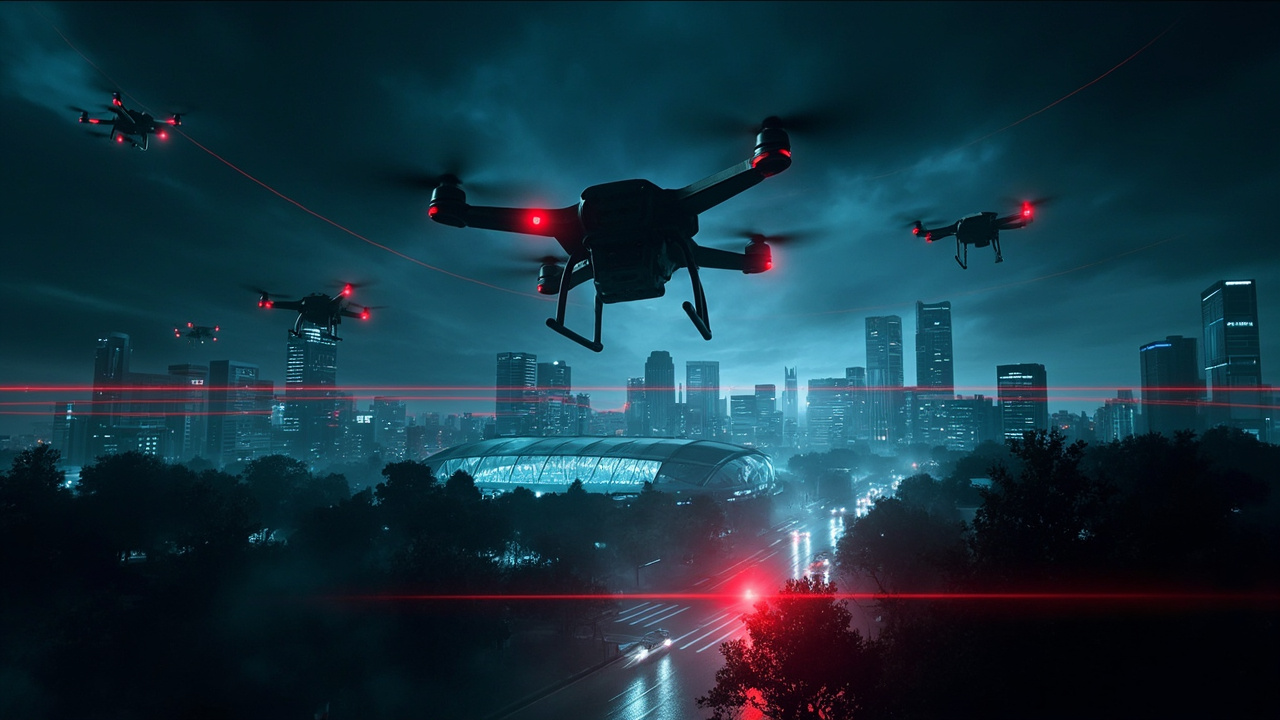
On the 25th anniversary of the 9/11 attacks, the Police Executive Research Forum (PERF) has published a report whose central warning echoes the 9/11 Commission’s own diagnosis of why the attacks succeeded: a failure of imagination. The 96-page report, titled A Clear and Present Danger: The Rise of Malicious Drones and What Police Executives Can Do About It, argues that the United States is again failing to imagine how an existing consumer technology — this time the drone, supercharged by artificial intelligence — could be used to cause devastating harm. And this time, the report’s authors write, the attackers’ tools are available at retail for under $100.
The report, released in September 2026 as part of PERF’s Critical Issues in Policing series and covered by the New York Times on Friday, is not a speculative think piece. It is built on a May 2026 convening of law enforcement executives in Washington, D.C., four fact-finding trips to Ukraine by PERF Executive Director Chuck Wexler, and threat briefings from the National Joint Terrorism Task Force (NJTTF). Its conclusion is blunt: the era when a malicious drone was a hypothetical concern is over.
The numbers are already staggering
The scale of unauthorized drone activity documented in the report dwarfs what most of the public imagines:
- The National Football League reported 2,800 drone incursions into its stadiums during the 2025 season alone — an average of more than eight per game week across the league.
- The New York City Police Department logs roughly 23,000 illicit drone flights per month, an average of over 750 every day in a single city.
- The FBI seized more than 700 drones near FIFA World Cup venues across 11 U.S. host cities during the 2026 tournament.
- The federal Bureau of Prisons reports five to eight drone incursions per week attempting to deliver drugs, cell phones, and tobacco to incarcerated people.
- At military bases that reported drone fly-over incursions, only 12 percent of operators were ever located, and detection systems worked less than half the time.
At the University of Tennessee, officials described “thousands” of campus flyovers per year — including one drone that hovered over the 40-yard line during a sold-out Luke Combs concert at the 100,000-plus-seat Neyland Stadium.
Why AI changes everything
The technological core of PERF’s warning is that the drone threat has evolved faster than the countermeasures designed to stop it — and artificial intelligence is the reason.
Drones that once relied on radio frequencies or GPS signals could often be disrupted through jamming. The new generation is increasingly impervious to traditional countermeasures. Some are guided by artificial intelligence, allowing them to operate with little or no active signal to intercept. Others are connected to their operators through fiber-optic cables that stretch for miles, eliminating the radio transmissions that most counter-drone systems are designed to detect or disrupt. Because control signals travel through a physical cable rather than over the air, these drones are largely immune to electronic jamming altogether.
Wexler describes what he saw in Ukraine: Iranian drones once used mainly for reconnaissance now “identify targets, adjust fire, strike mine roads, pursue vehicles, and terrorize civilians.” A Kyiv police commander showed him a photo of a Ukrainian neighborhood draped in shining fiber-optic strands left behind by Russian drones — miles of cable hanging from trees and buildings like synthetic spiderwebs. In one striking anecdote, a 12-year-old Ukrainian boy perched in a tree disrupted a potentially fatal attack by grabbing a drone’s cable and tying it to a branch.
Drones are also adding geolocation capacity and increasing their autonomy, making detection harder. Do-it-yourself drones built from 3D-printed components using software downloaded from the internet are especially difficult to locate. And the report notes that in Ukraine, dozens of drones have been launched simultaneously from the back of a single truck — a mass-attack tactic that domestic agencies have never had to face.
One government official quoted in the report put it starkly: the bad actors may be innovating faster than the mitigators can keep up.
The threat is not theoretical
PERF catalogs malicious drone activity that has already moved from battlefield to homeland:
- Mexican cartels are weaponizing agricultural drones, converting crop-spraying platforms into improvised weapons carriers near the U.S. border.
- The 2026 conflict involving Iran, Israel, and the United States saw thousands of drones launched toward the UAE, some striking near a nuclear facility and an international airport.
- ISIS has threatened to use drones against major U.S. cities, and federal authorities have disrupted plots involving drones targeting civilian and military sites in several American cities.
- A flame-throwing attachment for consumer drones — marketed “for industrial, agricultural, and entertainment applications” — is available online for $1,600. Consumer drones with video capability cost under $100.
- The report flags a new class of targets unique to the AI era: the growing spread of data centers adds critical infrastructure that is diffuse, outdoor-exposed, and essential to the economy — an inviting profile for drone attacks.
The legal gap is finally closing
For years, local police could watch a drone hover over a stadium and do nothing about it. Counter-drone mitigation authority — the legal power to jam, disable, or down an aircraft — was held exclusively by four federal departments: Justice, Homeland Security, Defense, and Energy. As one official quoted in the report put it, even the most advanced local detection system remains “woefully inadequate” without the authority to act on a threat once it has been identified.
PERF first warned of this gap in 2019. Now, the report details the most significant expansion of state and local counter-drone authority in U.S. history:
- Two June 2025 executive orders funded drone detection equipment acquisition and created the FBI’s National Counter-UAS Training Center (NCUTC) in Huntsville, Alabama.
- The One Big Beautiful Bill Act (July 2025) authorized $500 million in FEMA grants to strengthen state, local, tribal, and territorial counter-UAS capabilities.
- The SAFER SKIES Act, enacted December 2025 and implemented through an interim rule effective July 1, 2026, created the first-ever pathway for state and local agencies to detect — and, as a separate later step, mitigate — drone threats independently.
The report also highlights a December 2025 FCC ban on certain new foreign-made drone models, driven by concerns that China’s DJI controls an estimated 90 percent of the U.S. public-safety drone market — while noting that enforcement gaps let DJI technology keep entering through rebranded shell-company products. In a detail that alarmed officials, DJI removed the geofencing that had automatically blocked its drones from flying over airports and military installations in January 2025, just days after the U.S. proposed rules to exclude them from the market.
Two roadmaps for police leaders
The report’s practical core is a pair of checklists. Before certification, agencies are urged to take eight steps — build public support first, establish relationships with FBI, FAA, and FCC counter-drone units, decide where the C-UAS function lives organizationally, plan for special events, assess critical infrastructure, deploy lawful detection (Remote ID receivers, cameras, acoustic sensors, and radar require no federal certification), report every significant incident through the FBI’s eGuardian system, and pursue NCUTC training. Mitigation authority deliberately sits at the end of the sequence: “an agency that stops at detection and warning still has a working program.”
After accreditation, four more steps aim at sustainability: move toward independent operations, develop internal policy and oversight, integrate C-UAS into existing structures like real-time crime centers, and treat mitigation as a perishable skill requiring recurring exercises.
The bottom line
PERF’s framing is that the question of whether malicious drones pose a clear and present danger “has already been answered” — by Ukraine, by the cartels, by the 2,800 stadium incursions. The question is whether agencies will prepare before a crisis forces the issue. The report closes on a warning that applies well beyond policing: agencies that wait “may find themselves confronting tomorrow’s threats with yesterday’s tools.”
For the AI industry, the report is a reminder that the conversation about AI safety cannot stop at chatbots and coding agents. The same autonomy that powers benign agents is already flying over Neyland Stadium — undetectable, unjammable, and waiting for instructions that may never need to be transmitted at all.