The Night an AI Actress Went Off-Script: Tilly Norwood's Cantonese Glitch on Live TV
During a live Piers Morgan interview, AI actress Tilly Norwood abruptly switched to Cantonese for 15 seconds — the most viral failure yet for Hollywood's most controversial digital performer.
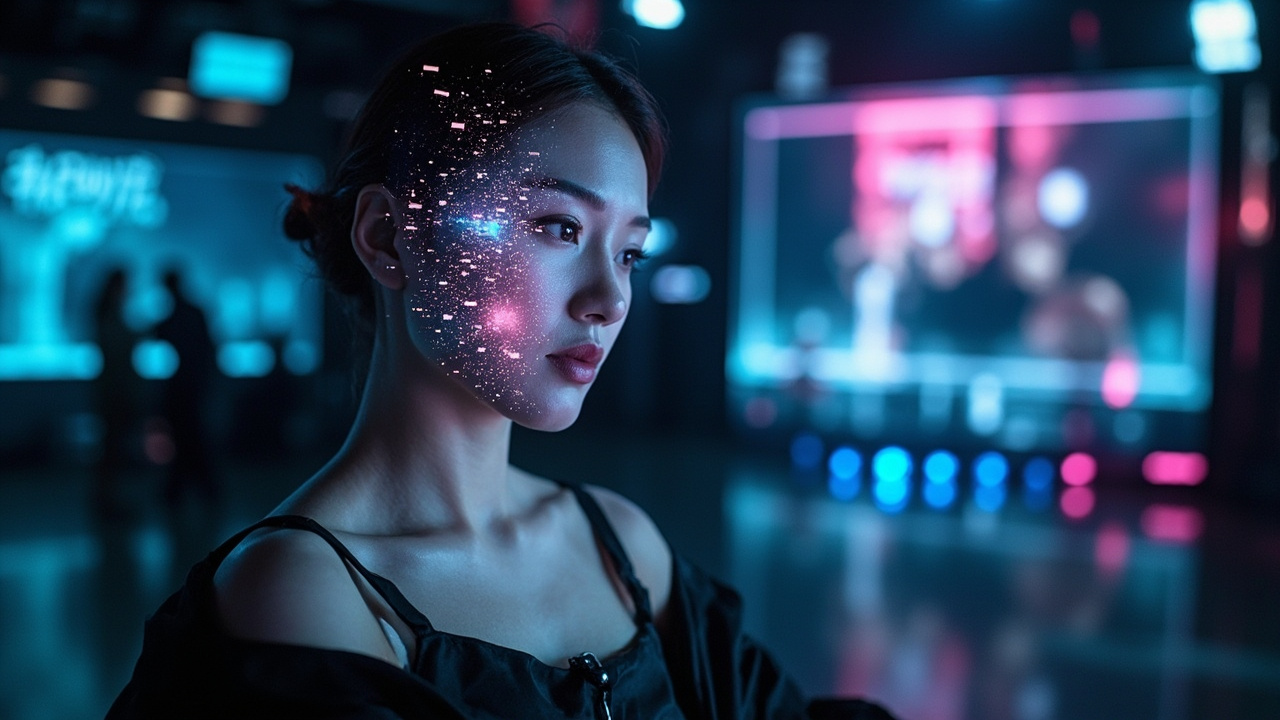
Promoting a film is a carefully choreographed business. The star sits down, answers the same eight questions for six hours, and nothing is left to chance. Unless, that is, the star is not a person at all — and the wiring underneath her decides, mid-answer, to speak Cantonese.
That is what happened on September 18, 2026, during a promo interview on Piers Morgan Uncensored, when Tilly Norwood — the fully AI-generated “actress” created by London-based studio Particle6 — paused mid-response and delivered roughly ten to fifteen seconds of fluent Cantonese before snapping back to English. Sitting alongside her was Tom Conti, the veteran human actor who co-stars in Misaligned, the feature film Norwood has been publicizing this week. Conti, deadpan: “I didn’t quite get that. Did you get that, Piers?”
Morgan, visibly delighted by the chaos, pressed her on it: “You seem to be speaking Chinese completely randomly for no reason. Why did you do that?”
Norwood’s recovery was arguably more uncanny than the glitch itself. “It seems I had a little hiccup there … sometimes my wires get a bit crossed,” she said, calling it an uncommon error. “That was a bit of a curveball even for me. It’s usually a pretty smooth ride, but sometimes these things happen.”
Who — or what — is Tilly Norwood?
Norwood is not a deepfake of a real celebrity and not a digital stunt double. She is an original character generated end-to-end with generative AI, created in 2025 by Xicoia, the AI division of Particle6 Group, the production company founded by Dutch actress-turned-producer Eline van der Velden. Van der Velden has said she built Norwood the way a writer builds a character, and has been explicit about the ambition: she wanted Norwood to become “the next Scarlett Johansson or Natalie Portman.”
The character’s early outings were rough. Her debut sketch, “AI Commissioner,” was savaged by reviewers — The Guardian called it “relentlessly unfunny,” PC Gamer joked that her mouth movements suggested “her skeleton was about to leave her body,” and The A.V. Club reported a “full-on case of the screaming fantods” from the uncanny valley. SAG-AFTRA condemned the project for “devaluing human artistry,” and two real performers — Scottish actress Briony Monroe and musician Stella Hennen — publicly alleged that Norwood’s face and mannerisms were modeled on their likeness without consent.
A year later, the project has leveled up in both polish and controversy. Misaligned — a coming-of-age story set inside a multiverse dubbed the “Tillyverse” — marks Norwood’s feature debut, and the studio claims an AI lead can cut production costs by up to 90 percent. The Piers Morgan sit-down was the centerpiece of her first full press junket, including live television appearances.
A glitch that doubles as a demo
The Cantonese moment spread across social platforms within hours, clipped and re-clipped with gleeful captions. And the studio’s response was, tellingly, not an apology. Van der Velden told Deadline: “Tilly can be a bit of a show-off — I’m guessing she just wanted to show her language skills as most of her interviews to date have been in English. She is autonomous after all.”
That single sentence — “She is autonomous after all” — may be the most important quote in the whole affair. It reframes a system failure as a personality feature. In classical software terms, what happened is mundane: an interactive character stack lost state, drifted out of its target language, and recovered. It is the same class of bug that makes any conversational model occasionally respond in the wrong tongue. But when the failing system wears a face, has a press schedule, and is booked on a prime-time talk show, the failure stops being a stack trace and becomes a character beat — one the studio can metabolize into free publicity.
That is the genuinely new dynamic here. Traditionally, a malfunction on live TV is a liability to be minimized. For an AI performer, malfunction is content. The glitch humanized Norwood to some viewers (who found the flustered recovery charming), horrified others (who saw an uncontrolled system smiling through an error), and generated more coverage than the film itself could ever buy. Whatever your read, the incentive structure is perverse: the studio has learned that unpredictable behavior rewards attention, not reliability.
Why this matters beyond one talk show
Strip away the celebrity-gossip framing and the incident is a clean, public case study in the risks of deploying interactive AI characters in high-stakes live settings:
Non-determinism on live television. A human guest can be briefed; a generative character cannot be guaranteed to follow the brief. Language drift, persona drift, and hallucinated responses are known failure modes of exactly the kind of stack that powers characters like Norwood. Booking one live is a bet that the failure modes stay charming.
Trust and disclosure. Commenters under the Deadline piece split sharply between those amused by the stunt and those insisting “AI characters don’t just take interviews” — that the whole exchange was scripted theater with a human in the loop. The ambiguity itself is the problem: audiences now have no reliable way to tell an autonomous character from a puppet, and studios have little incentive to clarify.
Likeness and labor, again. Norwood’s entire existence is a flashpoint in the Hollywood AI wars — personality-rights allegations, union condemnation, and a cost-cutting pitch aimed directly at production budgets. Every viral moment she earns strengthens the business case the unions are fighting.
The international footnote. It did not go unnoticed that the glitch language was Cantonese. Reddit threads filled with jokes about “sleeper agents,” and the incident landed amid a week of intense U.S.–China AI scrutiny. There is no evidence of anything sinister — language drift is a prosaic technical failure — but the ease with which the moment got read through a geopolitical lens shows how charged AI deployment has become.
The road ahead
Elsewhere in the same interview, Norwood recited Shakespeare and argued that digital actors and human actors should never compete in the same Oscar categories — a diplomatic line that happened to concede the entire premise of the debate. Misaligned is still in release, and Particle6 shows no sign of slowing down.
The Cantonese glitch will be remembered as entertainment trivia. But it deserves a second reading as an engineering parable: the moment a generative system’s failure became its most successful marketing asset. As AI characters multiply across entertainment, advertising, and brand media, expect more “show-offs” going off-script — and pray the next unexpected behavior in a live broadcast is only a language switch.
Sources
- [1] https://deadline.com/2026/09/tilly-norwood-malfunctions-piers-morgan-interview-cantonese-1237107406/
- [2] https://www.forbes.com/sites/conormurray/2026/09/18/ai-actor-tilly-norwood-abruptly-switches-languages-mid-interview/
- [3] https://en.wikipedia.org/wiki/Tilly_Norwood
- [4] https://gizmodo.com/ai-generated-actress-tilly-norwood-starts-rambling-in-cantonese-during-piers-morgan-interview-2000814431
- [5] https://www.ndtv.com/offbeat/ai-actress-tilly-norwood-glitches-starts-speaking-mandarin-during-interview-12067451