A Torpedo With No Crew: Inside Operation BROADSWORD, the AUKUS First That Armed an Undersea Drone
The US Navy has confirmed XV Excalibur fired a Mk 48 heavyweight torpedo at BUTEC on 13 September — the first allied launch of a lethal weapon from an autonomous submarine, done in under seven months under Operation BROADSWORD.
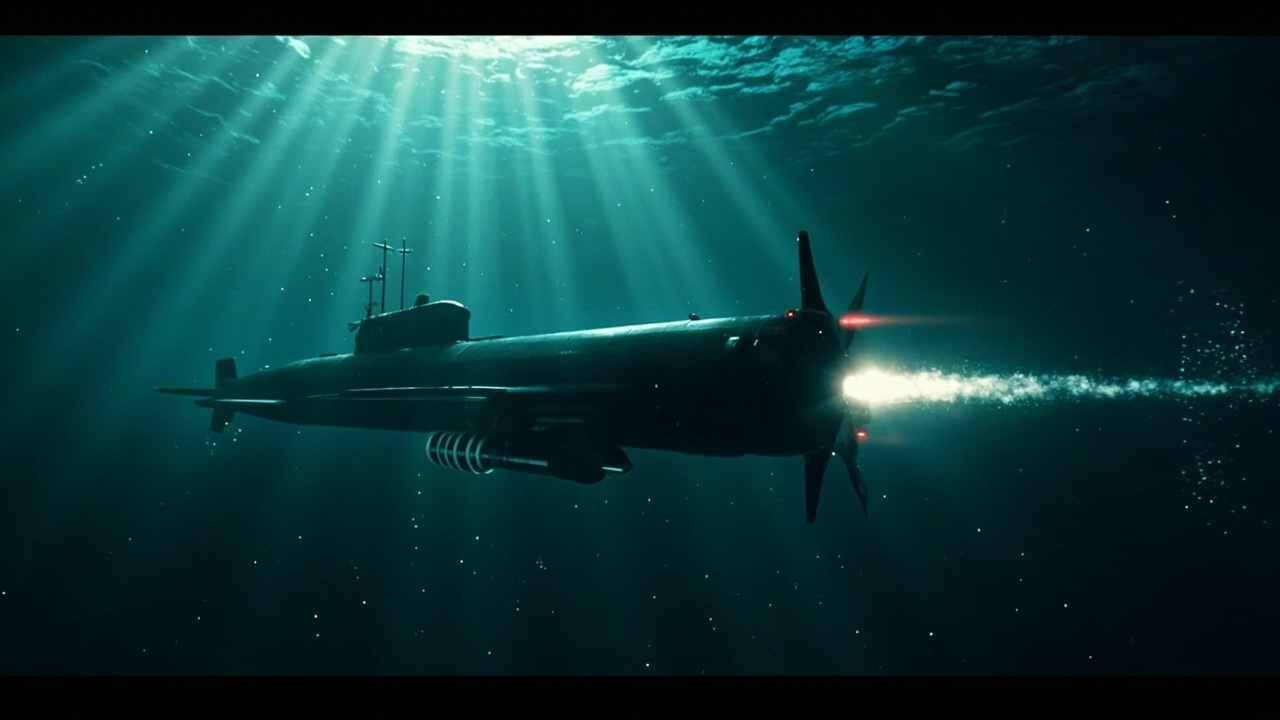
For most of naval history, the heavyweight torpedo has been the exclusive weapon of the crewed submarine — a 1.6-tonne steel hunter guided from a hull full of sailors. Last week that monopoly quietly ended. On 22 September, the British government and the US Navy confirmed that a Royal Navy extra-large uncrewed underwater vehicle, XV Excalibur, had fired a US Mk 48 heavyweight torpedo in UK waters — the first time either nation had launched such a weapon from an autonomous undersea platform rather than a crewed boat.
The confirmation landed, with deliberate choreography, as UK Prime Minister Andy Burnham arrived in New York for the UN General Assembly and his first meeting with President Donald Trump. But the event itself was older and more technical than the summit gloss suggested: the US Navy later verified that the proof-of-concept firing took place on 13 September at the British Underwater Test & Evaluation Centre (BUTEC) in Scotland, under the AUKUS Pillar 2 programme, in an effort named Operation BROADSWORD.
What actually happened
The vehicle at the centre of the trial is XV Excalibur, a 12-metre, roughly 19-tonne XLUUV built by Plymouth-based MSubs and formally named at Devonport in May 2025. Displacing about 41,887 pounds, it is the largest uncrewed submarine the Royal Navy has ever operated, conceived from the start as an experimental demonstrator for underwater autonomy, bespoke payloads, and crewed-uncrewed teaming concepts rather than an operational warship.
The weapon was a Mk 48 — the US Navy’s standard submarine-launched heavyweight torpedo, designed to kill surface ships and deep-diving submarines. Analysis by Navy Lookout suggests the specific variant was the Mk 48 Mod 7 Common Broadband Advanced Sonar System (CBASS) version, the product of a bilateral US–Australian heavyweight torpedo development programme — which is why Downing Street described the weapon as “jointly developed by the US and Australia” and framed the trial as a three-nation AUKUS achievement.
There is an engineering wrinkle worth pausing on. Excalibur has no torpedo tubes. Its large central payload bay, with doors top and bottom, cannot swallow a 5.8-metre Mk 48. Official imagery confirmed what analysts had suspected: the exercise torpedo was carried on a cradle temporarily attached to the underside of the hull. The US Navy stressed the weapon used was an exercise round, and that the trial’s purpose was proving the mechanical, electrical and software interfaces needed to deploy an American weapon from a British autonomous vehicle — not demonstrating a warshot.
US Chief of Naval Operations Admiral Daryl Caudle called the test “a historic first for allied undersea warfare,” saying it “validates our shared vision for true interchangeability” — the ability of allied platforms to fire each other’s weapons, share mission architectures, and scale combat power without bespoke engineering for every pairing.
Seven months from approval to firing
The speed is arguably the most significant detail. Project Broadsword was approved by the US Department of the Navy’s Rapid Capabilities Office (DONRCO) in February 2026 and reached a live firing in less than seven months. Vice Admiral Seiko Okano, who directs the RCO, was blunt about the philosophy: “We are not waiting 10 years for a single bespoke platform; we are pioneering a modular, software-defined, open-systems approach that integrates allied hardware with commercial innovation to rapidly scale distributed lethality.”
That timeline would have been unthinkable under traditional submarine acquisition, where new capabilities routinely take a decade or more. The trial brought together the Royal Navy, OPNAV N97 (the US Navy’s submarine warfare directorate), the Defence Innovation Unit, Naval Undersea Warfare Center Keyport, and industry partners — a coalition deliberately assembled to move at commercial-software tempo rather than programme-of-record tempo.
The next phase is already named: Project CUTLASS, which will shift the experimentation to Anduril’s Dive-XL extra-large uncrewed underwater vehicle and examine payload integration, command-and-control architecture, and tactical employment as the three AUKUS nations develop autonomous undersea systems alongside their crewed fleets.
The strategic frame: NATO’s undersea advantage
The geography is not incidental. Western navies have spent two years alarmingly aware of their vulnerability under the sea — seabed infrastructure sabotage in the Baltic, cable cuts off Norway and Taiwan’s outlying islands, and repeated Russian surveillance activity near critical infrastructure. BUTEC itself sits at the Kyle of Lochalsh in western Scotland, within sight of the sea lanes where much of that concern concentrates. Down…
The firing also builds directly on earlier AUKUS autonomy work. During Exercise Talisman Sabre in July 2025, an operating centre in Australia — more than 16,000 kilometres from Excalibur’s home in Plymouth — remotely controlled the vehicle in UK waters, an exercise the Royal Navy called “a big step forward in our ability to operate uncrewed systems interchangeably with Australia.” The torpedo trial adds the lethal half of the equation to that command-and-control foundation.
RUSI senior research fellow Sidharth Kaushal told AFP the test was “noteworthy” precisely because “the employment of a lethal payload illustrates that uncrewed systems can play roles which extend beyond surveillance.”
The hard questions a demonstration doesn’t answer
Navy Lookout’s analysis is a necessary corrective to the headline excitement: a successful technology demonstration is not an operational capability, and nothing in the trial showed autonomous decisions to use force. The genuinely hard problems are all still ahead — how an armed uncrewed vessel receives targeting information, how it maintains reliable command links through seawater (which attenuates radio brutally), and how human authorisation to fire is preserved when communication is intermittent by physics rather than by failure.
Those questions matter well beyond naval engineering. The UK-US AI and Autonomy partnership announced the same week pairs Britain’s Rapid AI Delivery Taskforce with the US Department of War’s Chief Digital and Artificial Intelligence Office, and “trusted” autonomy is the phrase both governments reach for. Trust, in this context, is a systems-engineering problem: kill-chain latency versus human-in-the-loop guarantees, tested under realistic conditions. Operation BROADSWORD proved the weapon can leave the drone. It did not prove — and was not designed to prove — that the decision chain around that weapon is ready for wartime.
Vice Admiral Robert Gaucher, the US Navy’s Director of Submarine Programs, put it with appropriate restraint: the firing “is an important early step in developing lethality in our undersea autonomous systems.”
Why this matters for AI, not just navies
Strip away the salt water and this is one of the clearest public proofs yet that autonomous agents are crossing from analysis into action in high-stakes physical domains. The undersea environment is arguably the hardest place to do it — no GPS, almost no communications, and a vehicle that must navigate, classify and (eventually) engage with long periods of independence from human operators. The technologies being hardened here — autonomous navigation, sensor fusion, payload integration, interoperable command architectures — are the same building blocks showing up in civilian robotics, subsea inspection, and the agent frameworks now reshaping software.
For AUKUS, the trial is a proof point that Pillar 2’s collaborative model can deliver at speed. For the broader AI industry, it is a reminder that the frontier of autonomy is no longer only chatbots and coding agents — it is 19 tonnes of autonomous steel leaving Plymouth with an allied torpedo on its belly, and the doctrine, law, and engineering of human control racing to keep up.
Sources
- [1] https://www.gov.uk/government/news/prime-minister-drives-global-work-on-artificial-intelligence-at-unga-as-uk-and-us-make-history-with-firing-from-undersea-drone
- [2] https://ukdefencejournal.org.uk/british-drone-submarine-fires-torpedo-off-scotland/
- [3] https://www.navylookout.com/royal-navys-autonomous-submarine-fires-heavyweight-torpedo-in-aukus-trial/
- [4] https://www.abc.net.au/news/2026-09-22/aukus-us-uk-torpedo-test-fire-unmanned-submarine/107179898
- [5] https://news.usni.org/2026/09/22/u-s-u-k-launch-torpedo-from-royal-navy-unmanned-submarine