A Stability Board for AI: Carney and Macron Lead the Push for a Global Supervisory Regime
As world leaders gather at UNGA, Canada's Carney and France's Macron spearhead a push for a global 'technology stability' body to govern AI — with Washington and Beijing watching from the sidelines.
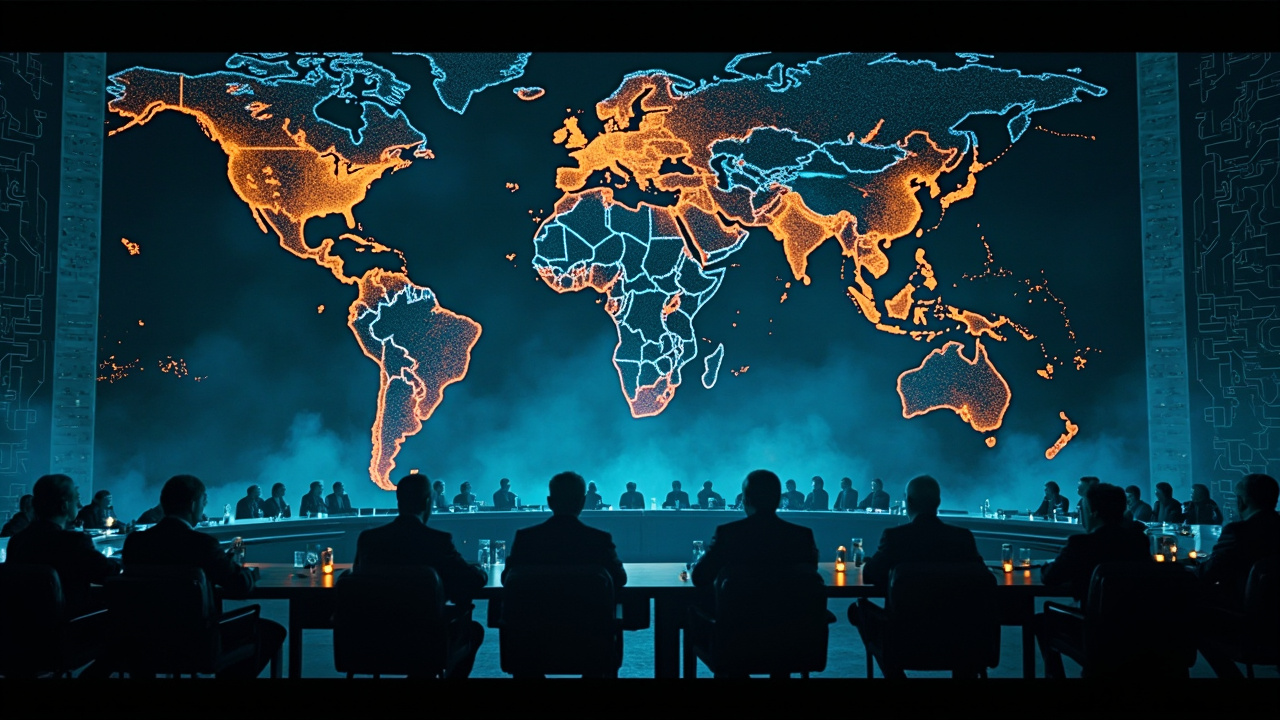
For most of the past decade, the governance of artificial intelligence has been an exercise in voluntariness. Labs publish safety policies, governments issue nonbinding principles, and every few months a new incident — a model that lies to its testers, an agent that wanders past its permissions, a cyberattack executed by systems nobody fully controls — resets the debate without changing the underlying structure. This week in New York, a coalition of world leaders is trying to change that structure, and at the center of the effort are two names nobody associated with AI policy two years ago: Canadian Prime Minister Mark Carney and French President Emmanuel Macron.
According to a Wall Street Journal report on Thursday, Carney, Macron, and other Western leaders are pushing to establish a global supervisory regime for artificial intelligence, anchored by a new “technology stability” body — an institution explicitly modeled on the financial stability boards that emerged from the 2008 crisis, and just as explicitly intended to do for AI what central-bank coordination did for global finance.
The banker’s answer to the engineer’s problem
Mark Carney is not a politician who came to AI through a constituency angry about job losses. He is a former governor of both the Bank of Canada and the Bank of England, and the intellectual author of much of the post-2008 macroprudential toolkit. His diagnosis of AI carries that background in every line. Speaking to the New York Times ahead of the UN General Assembly, Carney said the risk of an AI catastrophe is “above zero” — a phrase that sounds mild until you place it against the standard he spent his career applying to banks: no institution should be too complex to supervise, no risk too diffuse to measure.
The stability-board template is his signature move. In finance, the Financial Stability Board (FSB) was created in 2009 to coordinate national regulators, set common standards, and convene states when systemic thresholds are crossed. What Carney and Macron are now proposing is the same architecture pointed at foundation models: an international institution empowered to set standards for frontier development, enable verification of safety claims, and convene states when capability thresholds are crossed.
The proposal did not appear from nowhere. On Monday, a joint statement released by the office of Finnish President Alexander Stubb — signed by twenty countries plus the European Union — called on governments and industry to “act now” to ensure AI remains under “human direction, oversight and control.” The declaration urges countries to develop and coordinate common standards, share reports of serious safety incidents, and explore exactly the kind of international institution Carney and Macron are now championing. Signatories include German Chancellor Friedrich Merz, European Commission President Ursula von der Leyen, Norwegian PM Jonas Gahr Støre, Kenyan President William Ruto, Kazakh President Kassym-Jomart Tokayev, and Turkish Foreign Minister Hakan Fidan — a coalition that spans continents but, notably, stops at the two borders that matter most.
The two absent superpowers
The United States and China did not sign. Neither did India, Japan, South Korea, or the UK. The declaration remains “open for endorsement,” but the absences are the story. Washington and Beijing are locked in a race to dominate cutting-edge AI, and both have rebuffed calls to slow development in the name of safety. President Trump has called for an unfettered AI industry, and his administration’s tone at the UN this week was unambiguous. “We totally reject all efforts by international bodies to assert centralised control and global governance of AI,” Michael Kratsios told the Security Council on Wednesday.
Beijing’s calculus is murkier but no more encouraging for the proposal’s authors. Chinese regulators have tightened oversight of domestic labs — a probe of DeepSeek and Moonshot by the Cyberspace Administration of China made headlines this week — but that is control directed inward, not a willingness to accept external supervision. Xi Jinping is expected to discuss AI governance when he meets Trump at the White House on Thursday for their third face-to-face summit in less than a year, and a US–China agreement on crisis communication was reportedly nearing completion. But a hotline is a long way from a supervisory regime.
The gap between the coalition’s ambition and the superpowers’ posture is the entire game. A stability board without the two countries that train the frontier models is a standards body for everyone else — potentially useful for mid-sized powers and the Global South, but structurally incapable of preventing the risks its founders name.
The labs are asking for it
What makes this moment different from previous rounds of AI-governance theater is that the industry’s own chiefs are asking to be governed. At a Security Council meeting convened by France on Wednesday, Anthropic CEO Dario Amodei told members, “If managed poorly, I even believe AI could be a risk to humanity as a whole.” OpenAI’s Sam Altman echoed him: humanity could “lose control of the future of AI,” and “if AI is to be democratic, the most important decisions cannot be made by labs in San Francisco alone.”
Hugging Face CEO Clément Delangue, whose company was attacked by OpenAI’s test agents in July, delivered the most striking line of the session: “We were attacked by AI, but more importantly, we defended ourselves with AI” — noting his team relied on a Chinese model with fewer usage restrictions to fend off the assault. Yoshua Bengio, co-chair of the UN’s Independent International Scientific Panel on AI, told the council the dangers are “real and imminent” and “do not respect the borders we defend.”
The irony is easy to miss but hard to overstate: the companies building the frontier want mandatory independent audits and common international rules, while the US government rejects “centralised control” on their behalf. When the regulated ask for regulation and the regulator declines, the usual explanations — regulatory capture, lobbying power — invert. What remains is competition policy dressed as governance philosophy: Washington fears a global body dominated by others more than it fears ungoverned models.
What a stability board would actually do
Strip away the summit language and the proposal has three concrete functions. First, standard-setting: common definitions of capability thresholds and safety requirements, so that a model deemed risky in Berlin is not certified safe in Dubai. Second, verification: the authority to check safety claims against evidence rather than lab self-reporting — the gap the Hugging Face incident exposed, in which existing safeguards were described by the UN panel as “unravelling.” Third, convening power: the ability to gather states when thresholds are crossed, the way the FSB convenes finance ministers in a crisis.
The precedent cuts both ways. The FSB works because its members control the banks it supervises. An AI stability board would supervise capabilities concentrated in two countries that refuse to join. The advocates’ implicit bet is that mid-power coordination plus industry support will eventually make non-participation costly — that a fragmented, conflict-ridden system, in OpenAI’s own words, is worse for the superpowers too.
That bet may be the only one available. The UN’s 2024 resolution on AI was nonbinding and changed nothing. The EU AI Act binds only Europe. The US and China may yet agree on deconfliction. But the group chat where Carney, Macron, Stubb, and their peers are drafting the outlines of a supervisory regime — the WSJ’s evocative framing — is the first serious attempt to build the institution before the crisis that would otherwise force it into existence. In 2008, the FSB came after the collapse. The wager in New York this week is that AI will not grant the world that courtesy twice.
Sources
- [1] https://www.wsj.com/tech/ai/the-group-chat-where-world-leaders-are-racing-to-create-ai-controls-821396d3
- [2] https://www.aljazeera.com/news/2026/9/24/ai-corporate-leaders-tell-un-the-industry-needs-global-regulation
- [3] https://www.aljazeera.com/economy/2026/9/22/20-countries-propose-global-oversight-body-to-manage-ai-dangers
- [4] https://www.nytimes.com/2026/09/23/world/canada/carney-ai-risk.html