Register or Face Prosecution: DOJ Recasts AI Data Center Opposition as Foreign Agentry
A DOJ warning that public demonstrations against AI data centers can trigger foreign-agent registration, paired with presidential posts branding critics as traitors, turns domestic infrastructure dissent into a counterintelligence file.
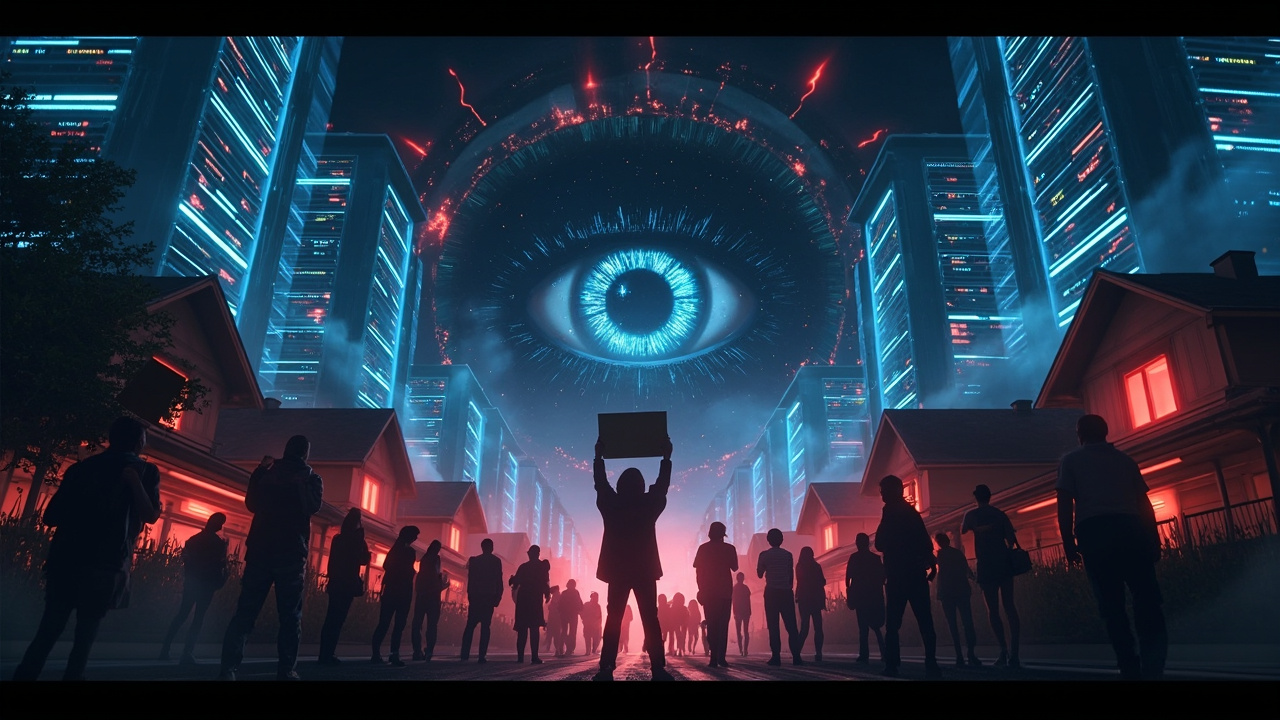
A little-noticed Justice Department warning issued last week has quietly redrawn the line around permissible speech on AI infrastructure. According to reporting by Ken Klippenstein published September 23, the DOJ instructed “citizens and noncitizens” alike that anyone who furthers the “goals” of a foreign power through “any public activity” — expressly including “public demonstrations” — must formally notify the government or face arrest and prosecution. The warning names no specific protest. But the context leaves little ambiguity about who is in the crosshairs: the diffuse, fast-growing movement of Americans opposing the buildout of AI data centers in their communities.
The warning and the posts that frame it
Two days before the DOJ guidance dropped, President Trump opened a barrage of social posts declaring opposition to AI a traitorous conspiracy traceable to Beijing. “There is a SICK conspiracy going on against AI and Data Centers, and the only one that is happy about it is China,” he posted on September 14, adding: “Conspiracy Theorists, Treasonists, Traitors, and Leakers, BEWARE!” In another post, he wrote that people who say “AI is going to destroy the World” and that “Data Centers are bad for your neighborhood… are Revolutionaries, but Revolutionaries for a Bad and Evil Cause.” And on September 19 he alluded to escalation: “we will also be looking for BAD, and we can do that, very easily, with our already existing Criminal and Civil Justice System.”
Stack those posts against the DOJ’s registration warning and the shape of the new posture is hard to miss. Speech that opposes AI infrastructure is no longer merely wrong-headed, in the administration’s framing — it is potentially an act of agency for a foreign principal under the Foreign Agents Registration Act (FARA), the 1938 statute originally aimed at wartime propagandists.
Congress got there first
The executive branch is following a trail already blazed on Capitol Hill. In June, Senate Intelligence Committee chairman Tom Cotton (R-AR) asked then-acting Attorney General Todd Blanche to investigate “foreign influence efforts targeting the buildout of American AI infrastructure,” citing “a network of foreign actors, led by the Chinese Communist Party (CCP)… attempting to manipulate U.S. policy and public opinion on data centers.” Cotton’s chief exhibit was Neville Roy Singham, the Shanghai-based American tech mogul whose network of left-wing U.S. nonprofits, Cotton claimed, has the Chinese government as its “ultimate paymaster.” His letter complained pointedly that “no entity in the [anti-AI] network has been charged under” FARA.
Days earlier, House Energy and Commerce chairman Brett Guthrie (R-KY) and other Republicans had asked FBI Director Kash Patel and the White House for a briefing on what they described as foreign influence campaigns aimed at blocking American data centers. “The fact that Chinese Communist Party-backed entities and other foreign adversaries may be attempting to influence decisions related to American data center infrastructure puts into perspective how serious of a fight we are in,” Guthrie said.
The private sector chorus has been singing from the same hymnal. David Sacks, the venture capitalist who served as Trump’s AI czar before moving to co-chair the President’s Council of Advisors on Science and Technology, has repeatedly framed domestic resistance as a gift to Beijing — “America is tying itself in knots: politicians and bureaucrats are banning new data centers… This is how you lose the AI race.” Kevin O’Leary, the investor behind a planned $100 billion Utah data center, claimed Chinese money was paying protesters — then conceded on June 25 that he had “no evidence,” after Fox News aired apologies. Two of the groups he named have sued him and Fox for defamation. (The Alliance for a Better Utah’s retort — “The only foreign interest in this data center is Kevin from Canada” — may be the best single line of the affair.)
The premise has a polling problem
The entire edifice rests on the assumption that ordinary Americans would not oppose data centers unless someone in Beijing were pulling the strings. The polling says otherwise, and overwhelmingly so. A Gallup survey conducted in March found that 71 percent of Americans oppose building an AI data center in their area — more than the 53 percent who oppose a local nuclear plant. Nearly half are strongly opposed, and the opposition crosses party lines, including 63 percent of Republicans. That is not a fringe; it is close to a consensus.
Nor is it raw technophobia. A February Pew survey of more than 5,000 adults found nearly half of Americans already use AI chatbots, yet 40 percent expect AI to hurt society over the next 20 years against 16 percent who expect it to help. What people distrust is the rollout: 63 percent said AI is advancing too quickly, 71 percent believe it will make their personal information less secure, and 67 percent have little or no confidence in the federal government’s ability to regulate it.
A pattern, not an aberration
This is not the first time the administration has played the national security card to clear the path for AI. In June, the DOJ intervened in an NAACP lawsuit against Elon Musk’s xAI over dozens of gas turbines running without air permits at a Tennessee data center, asking a federal judge to throw the case out on the grounds that the NAACP “threatens American national, economic, and energy security.” To drive the point home, the government filed a sworn declaration from the Pentagon’s chief digital and artificial intelligence officer, Cameron Stanley, attesting that Grok is “a matter of paramount national security.”
Klippenstein teases a follow-up revealing how the framework will be formalized “under a new government entity modeled off the military” — a detail worth watching.
Why this matters beyond Washington
The stakes here are larger than one warning letter. FARA carries criminal penalties, and extending its logic to unregistered protesters at a county zoning meeting converts routine civic participation into legal exposure. Legal analysts reviewing the DOJ warning noted that its express identification of “public demonstrations” as a trigger marks a significant expansion of the statute’s traditional application. First Amendment scholars have long warned that FARA’s breadth makes it a ready-made instrument for chilling disfavored advocacy; using it against infrastructure dissent puts that theory to a live test.
There is also a strategic irony the administration seems not to have priced in. When the 71 percent of Americans who don’t want a data center next door are told their preference is treasonous foreign propaganda, the likely result is not compliance but radicalization of suspicion — people wondering what the government is so eager to stop them from asking. Treating a consensus-level public concern as a counterintelligence matter may be the fastest way to manufacture exactly the crisis of legitimacy it claims to be preventing.
The AI buildout is real, the capital at stake is historically large, and foreign influence operations do exist. But conflating the three — so that every local objection becomes an act of agency for Beijing — is a category error with criminal consequences attached. The next test case, a county hearing or a picket line that ends in a FARA referral, will show whether the warning was a shot across the bow or the new rules of engagement.