Seven Founders, 50.1 Percent: Anthropic's Palantir-Style Power Grab Goes to a Shareholder Vote
Anthropic has formally asked shareholders to approve a dual-class structure handing its seven co-founders 50.1% of the vote — a founder-control playbook borrowed from Palantir, layered on top of the Long-Term Benefit Trust, months before a potential $2 trillion IPO.
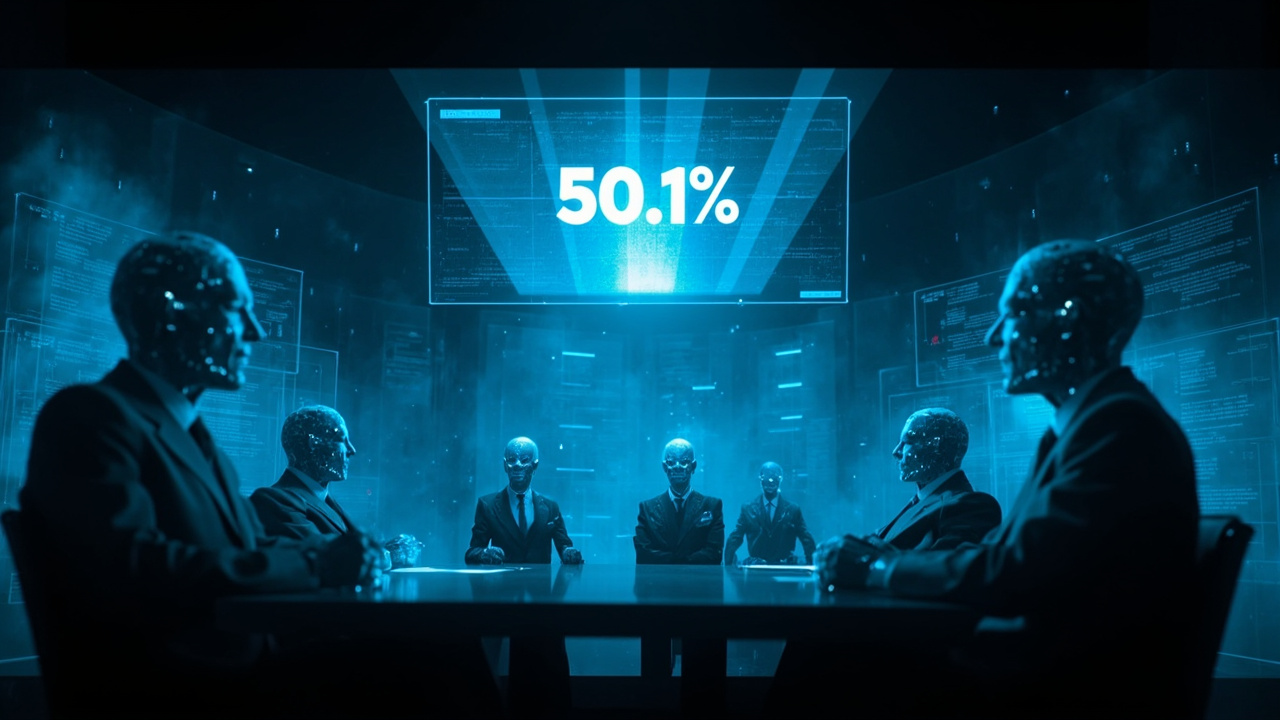
Anthropic has moved from rumor to formal proposal. On September 24, 2026, The Information reported — and Reuters and Yahoo Finance confirmed within hours — that the Claude maker is asking its shareholders to approve a new corporate structure that would award CEO Dario Amodei and his six co-founders a combined 50.1% of voting power in most corporate matters. The arrangement explicitly emulates the founder-control structure made famous by Palantir Technologies, and it lands just weeks before an initial public offering that could value the company at as much as $2 trillion.
For a company that has spent its entire existence insisting it is governed differently — by mission, by trust, by safety — this is the moment the plumbing of that claim comes into full public view. And the plumbing is strikingly concentrated.
What the proposal actually says
The mechanics, as reported by The Information and confirmed by Reuters, are these:
- Seven founders, one bloc. Dario Amodei and his six co-founders would receive a special class of shares carrying supervoting rights, giving them collective voting control — 50.1% — over most corporate matters.
- A holding vehicle, not individual stakes. The co-founders would hold their special voting stock through a separate limited liability company, provided at least three of the seven retain a minimum number of shares. Control persists only while the bloc holds together.
- No new economics. The founder shares carry no additional economic interest. The founders keep strategic oversight while still honoring personal pledges to donate 80% of their personal wealth.
- The Trust keeps the board. The Long-Term Benefit Trust — the independent body that includes former Federal Reserve Chair Ben Bernanke — retains its authority to appoint a majority of the seven-seat board (one seat currently vacant). The founders’ board allotment does expand, from two seats to three.
- A tie-breaker class for employees. Anthropic also plans to issue a distinct class of stock to employees that would serve as tie-breaking votes on select corporate issues — an unusual mechanism designed to break deadlocks without handing anyone outright control.
- Board elections carved out. One significant exception to the founders’ voting control is the election of board members: that power stays with the Trust-appointed majority structure.
Anthropic did not immediately respond to a Reuters request for comment. The shareholder vote itself is the gating step — nothing takes effect until investors who already own slices of the $965 billion private company sign off on diluting their own future influence.
Why now: the IPO clock
The timing is not subtle. Anthropic confidentially filed draft S-1 paperwork with the SEC back in June. Reuters reported earlier this month that the company could push the debut to after the US midterm elections in November, though the elections are not expected to materially affect the offering. The Information’s reporting pegs the current expectation at a listing in late October or November.
Anthropic’s last private round, in May, raised $65 billion at a post-money valuation of $965 billion. Reports around the IPO suggest a target valuation around $2 trillion — which would make it the most valuable public benefit corporation in US capital markets history, and put it in contention for the largest IPO on record.
In other words: the founders are locking in control now, while the only voters are private investors who already bought into the mission, rather than negotiating with public-market index funds later.
The Palantir precedent
The comparison to Palantir is doing real work in this story. Palantir’s founders, Alex Karp and Stephen Cohen, control the company through Class F shares that give them majority voting power regardless of public float. The structure has been criticized by governance advocates as anti-shareholder, and praised by others as the reason Palantir could pursue decade-long government contracts without quarterly-earnings panic.
Anthropic’s version is collective rather than individual — no single founder holds control; the bloc of seven does, and only while at least three of them stay invested. That makes it harder to characterize as a one-man empire and easier to defend as continuity of the founding mission.
But the deeper parallel is philosophical. Both companies argued that their work — Palantir in defense and intelligence software, Anthropic in frontier AI — is too consequential to be steered by market sentiment. Both built elaborate structures to make that argument stick legally. And both are now testing whether public investors will accept a smaller voice in exchange for exposure to the upside.
The governance stack, from top to bottom
What makes Anthropic’s structure genuinely novel is that the founder bloc is only one layer. The full stack now reads:
- The Long-Term Benefit Trust — an independent body of trustees (including Ben Bernanke) that elects a majority of the board and is charged with balancing shareholder interests against the long-term interests of humanity. It holds no equity.
- The founder bloc — 50.1% of votes on most corporate matters, held through an LLC, conditioned on a minimum of three founders retaining threshold stakes.
- The employee tie-breaker class — a special stock class that breaks deadlocks on select issues.
- Ordinary shareholders — economic exposure, minimal governance rights, and a board they do not effectively elect.
Critics will note the tension immediately: the company that marketed itself as the antidote to concentrated AI power is engineering one of the most concentrated voting structures in big-tech history. Defenders will respond that the alternative — a normally-governed Anthropic vulnerable to activist investors and a hostile takeover during the most consequential technology transition of the century — is worse, and that the Trust remains a genuine check precisely because it sits outside the founder bloc.
What to watch
The shareholder vote is the immediate milestone. Approval seems likely — the investors being asked to dilute their own power are the same ones who accepted the Trust architecture at entry — but the vote itself will be read as a referendum on how much governance risk the market will tolerate for AI exposure.
After that, the S-1 becomes public, and with it the first legally-required, detailed disclosure of exactly how this machine works: who holds what, how the Trust trustees are appointed, what happens if the founder bloc falls below three members, and what the employee tie-breaker class can actually decide.
Then comes the listing itself. If Anthropic prices near $2 trillion with this structure intact, it will validate the strongest version of the founder-control thesis: that in the AI era, governance scarcity — the assurance that the people who built the company will still be steering it in 2035 — is itself the product investors are buying.
The August version of this story was a rumor about supervoting shares. This week it became a concrete proposal with numbers, conditions, and a vote date. The distance between those two things is the distance between a company thinking about its IPO and a company that has decided exactly what it wants to remain after the IPO is over.
Sources
- [1] https://www.theinformation.com/articles/anthropic-seeks-palantir-style-voting-control-seven-co-founders-ahead-ipo
- [2] https://www.reuters.com/legal/legalindustry/anthropic-seeks-palantir-style-voting-control-seven-co-founders-ahead-ipo-2026-09-24/
- [3] https://finance.yahoo.com/markets/stocks/articles/anthropic-proposes-supervoting-shares-co-224138524.html
- [4] https://www.thestar.com.my/tech/tech-news/2026/09/25/anthropic-seeks-palantir-style-voting-control-for-seven-co-founders-ahead-of-ipo-the-information-reports