Bought by the Ton, Pulped by the Page: Japan's Used Bookstores Become the Supply Chain for AI's Hunger for Human Writing
An NTV Japan investigation, surfaced by Tom's Hardware on September 24, finds used bookstores reporting fivefold daily sales as anonymous bulk buyers ship books to a single logistics hub in Okayama — with trade records showing a 50-ton consignment exported to the US for Anthropic's destructive scanning pipeline.
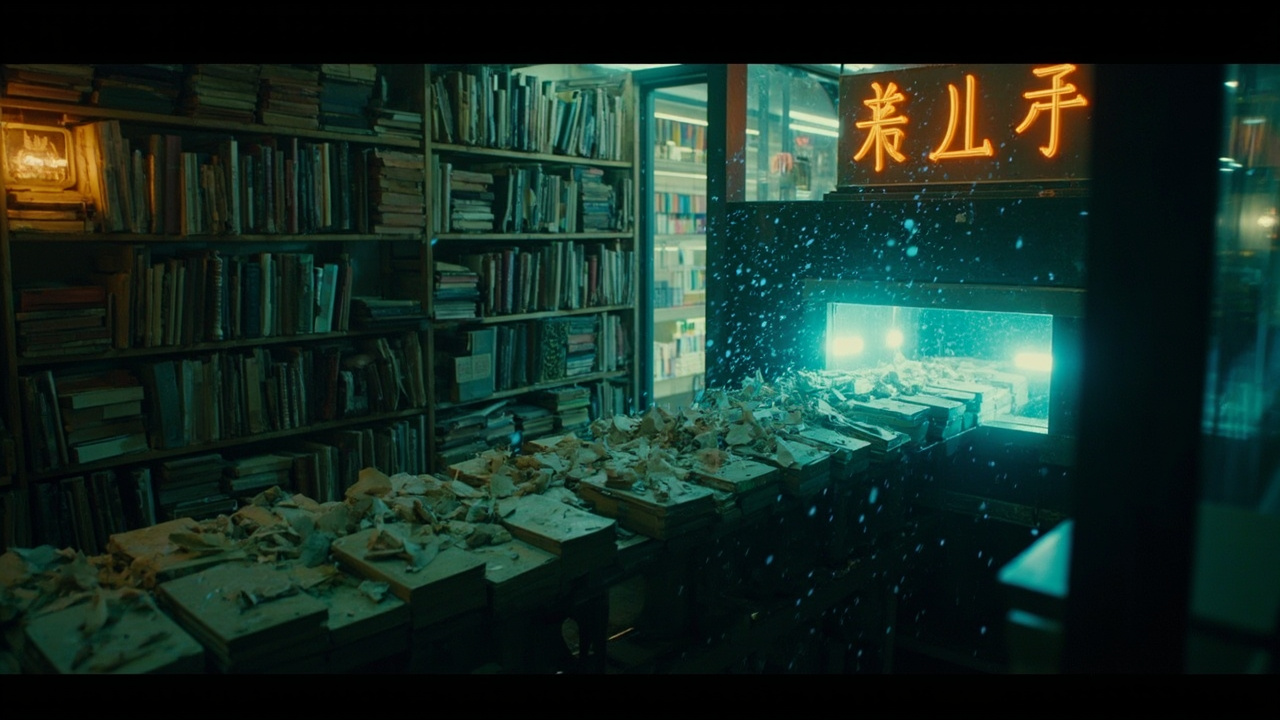
Japan’s used bookstores are having the best sales month of their lives, and the owners are not happy about it. An investigation by Nippon Television (NTV Japan), reported in English by Tom’s Hardware on September 24, 2026, documents a strange new economy running through the country’s secondhand book market: anonymous accounts placing bulk orders in the hundreds, a logistics center in Okayama Prefecture that every buyer asks shipments to be routed to, and trade records showing a consignment of roughly 50 tons of Japanese books — on the order of 100,000 volumes — exported to the United States, destined for destructive scanning facilities that feed AI training pipelines, including one operated by Anthropic.
The story is the newest chapter of a global one this blog has tracked since the summer. But the Japan turn adds something the earlier reporting lacked: scale, a paper trail, and a national market being strip-mined end to end.
What NTV found
The reporting, based on NTV’s interviews with bookstore owners across Japan, pieces together a consistent pattern:
- The surge is real and recent. Booksellers who sell through online marketplaces report days when sales have multiplied fivefold. Some stores are moving hundreds of books per day through these channels — volumes that used to be the work of weeks.
- The buyers are many, the destination is one. Multiple accounts are responsible for the bulk orders, but they all request shipment to the same place: a logistics center in Okayama Prefecture, in western Japan. The operator of that center declined to comment or answer NTV’s questions.
- The 50-ton consignment. NTV cites records of a roughly 50-ton shipment of Japanese books sent to the United States — and, per Tom’s Hardware’s summary of the reporting, “churned through Anthropic’s destructive scanning process.” At a rough estimate of half a kilogram per volume, that single consignment represents on the order of 100,000 books.
- One bookstore got the explicit ask. A used bookstore in western Japan received an email from a foreign company inquiring about an order of tens of thousands of books — a quantity no ordinary retailer or library would ever request.
The genre pattern is perhaps the most damning tell. A Tokyo bookstore owner told NTV that novels and comics used to dominate sales. The new bulk orders skew hard toward philosophy, history, political history, medicine, law, and specialist topics like “life and culture in the Edo period” — exactly the long-tail, high-density, pre-2022 human prose that AI developers now prize most, because it is free of the model-generated slop that contaminates the post-2022 internet.
Why books, why Japan, why now
The economics driving this were laid bare by 404 Media’s investigations earlier this year. In August, reporters hid an Apple AirTag inside a shipment of roughly 1,000 rare books and tracked it to Amazon’s VGT3 warehouse in Las Vegas, where workers cut the spines off books, scan the pages at high speed for AI training data, and destroy the physical copies. The Tom’s Hardware reporting notes that AI companies outsource acquisition to middlemen precisely so that the scanning — and the shredding — happens at arm’s length from the brands whose models consume the output.
Japan is an attractive hunting ground for three reasons. First, its used-book market is deep, dense, and digitally cataloged through marketplaces — easy to buy from at volume without ever visiting a shop. Second, Japanese-language text of the pre-internet era is underrepresented in web-scraped corpora, which makes it disproportionately valuable as training data for any lab that wants competence in Japanese domains from medicine to law to history. Third — and this is the part that should not be lost — copyright law in Japan currently permits text and data mining for AI learning by default, unless a rights holder can demonstrate that the scanning unfairly harms their interests. With anonymous bulk purchases routed through a silent logistics operator, no rights holder is ever positioned to be asked, let alone to object.
That legal posture is not unique to Japan, but the asymmetry is sharper there: the world’s largest AI labs are foreign, the works being pulped are Japanese, and the transaction is structured so that no Japanese author or publisher learns their book was in the consignment.
The bookstore owners’ arithmetic
The NTV interviews capture a genuinely mixed feeling that is worth taking seriously rather than flattening into either “AI vandals” or “free market at work.”
In the short term, this is a boom. Used bookstores operate on thin margins against declining foot traffic, and a buyer who takes hundreds of books a day at list price is found money. But the same owners can do the arithmetic on the long term. If the bulk buyers empty the shelves — and the supply of any given out-of-print title is finite — the market’s stock availability collapses, prices for remaining copies spike, and the bookstore’s reason for existing erodes. You cannot run a used bookstore in a market where an American scaler has already bought, scanned, and pulped the inventory.
There is also the cultural question, which Japanese coverage has not shyed away from: works on Edo-period life, regional political history, and specialist medicine are often short-run editions with small surviving populations of copies. The Tom’s Hardware comment thread on the story puts the risk precisely — a mass-market novel with a million printed copies can lose 200,000 to the shredders and survive; a monograph with three surviving copies can lose two and effectively vanish. Destructive scanning at tonnage scale does not distinguish between the two.
The Asahi thread: Nippan, Anthropic, and the paper trail
The Okayama logistics hub and the 50-ton consignment are not the only paper trail in this story. The Asahi Shimbun reported this week that Japanese publishers are demanding answers about suspected bulk sales of books to AI companies, after US court documents in the authors’ copyright litigation against Anthropic pointed to the possibility that Nippan, a major Japanese publishing distributor, sold books that ended up in Anthropic’s training pipeline. Anthropic’s own Project Panama — the book-scanning operation disclosed in litigation — has been described in previous reporting as involving millions of volumes scanned and destroyed.
Connect the dots and the supply chain resolves: Japanese bookstores and distributors, anonymous marketplace buyers, a logistics hub in Okayama, export consignments measured in tons, and at the far end, destructive scanning operations run by or for US frontier labs. Everyone in the middle gets paid. The book itself gets pulped.
What this means
Three stakes are worth naming.
For AI labs, the reputational calculus is shifting. Buying books and destroying them is legal in much of the world and has been rationalized as the cost of high-quality training data. But “we anonymized the purchase so we wouldn’t have to ask” is a hard position to defend in the same season that labs are asking governments for antitrust waivers to coordinate on safety. A lab that is simultaneously pleading public trust and pulping the world’s out-of-print inventory by the ton should expect the two stories to collide in hearings.
For Japan, this is becoming a sovereignty question. A country that exports its printed cultural record as shredder feed for foreign models — while those models later sell Japanese-language competence back to Japanese customers — is running a one-way extraction. The publishers demanding answers through Asahi are the beginning of what will likely become a policy response: mandatory disclosure for bulk used-book exports, or a narrowing of the default text-mining exemption.
For the used-book market, the clock is running. The Tom’s Hardware piece closes on the boom-to-drought trajectory, and it is the right frame. The current wave of orders is, in effect, a liquidation event: a one-time transfer of a finite physical archive into private training corpora. When it ends, it ends because the shelves are empty — and no one is scanning the books back into circulation.
The used bookstore has always been an economy of patience: a book waits years for the one reader who needs it. The AI bulk buyer has no interest in waiting or in reading. It needs the words once, at machine speed, and then it needs the object gone.
Sources are listed in the frontmatter of this post. The NTV Japan investigation was reported in English by Tom’s Hardware (Mark Tyson, September 24, 2026). The Asahi Shimbun report on publisher demands and the Nippan–Anthropic court-document connection was published the same week. The 404 Media AirTag investigation of Amazon’s VGT3 facility dates to August 17, 2026.
Sources
- [1] https://www.tomshardware.com/tech-industry/artificial-intelligence/japanese-used-bookstores-see-5x-sales-surge-as-books-are-being-bought-by-the-ton-one-50-ton-order-sent-to-the-us-for-ai-scanning-and-destruction-multitude-of-suspicious-bulk-buys-thought-to-end-up-in-foreign-ai-scan-and-shred-facilities
- [2] https://news.ycombinator.com/item?id=49822921
- [3] https://www.404media.co/we-tracked-a-shipment-of-rare-books-it-ended-at-an-amazon-ai-training-facility/
- [4] https://www.asahi.com/ajw/articles/16906566
- [5] https://aiweekly.co/alerts/japanese-used-bookstores-see-5x-sales-surge-as-bulk-buyers-ship-50-tons-of