'Paradise of Machines': Pope Leo Brings His AI Warning to the Heart of Secular France
Opening the first papal state visit to France in 18 years, Pope Leo XIV stood beside President Macron at the Élysée Palace and warned that humanity risks losing itself in a 'paradise of machines' — calling for urgent education in ethical discernment just days after AI CEOs briefed the UN Security Council.
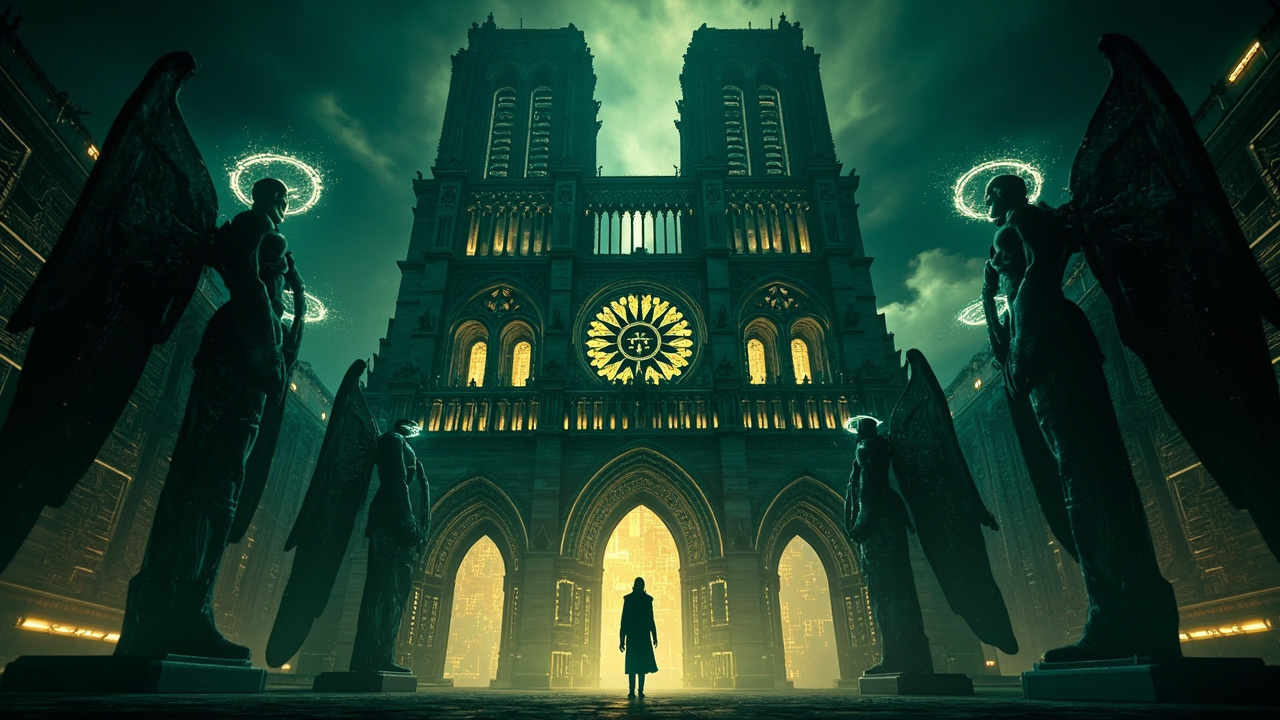
When Pope Leo XIV’s charter flight touched down at Paris Orly Airport on Friday morning, church bells tolled across France — a country that has kept church and state formally separated since 1905. It was the opening gesture of the first official papal state visit to France in 18 years, and by the evening the phrase that had traveled around the world from the Élysée Palace was not about liturgy or doctrine. It was about artificial intelligence.
“If we are to avoid losing our humanity amid a ‘paradise of machines’ invading and conditioning our daily lives, there is an urgent need for education in ethical discernment and the capacity to acknowledge the moral good,” Leo told President Emmanuel Macron and an audience of government and diplomatic leaders at the presidential palace.
The image is deliberately inverted. A paradise — of machines. A world of abundance and automation that, the Pope implied, could hollow out the very humanity it claims to serve. Delivered at the start of a four-day trip that is expected to draw upward of a million people into the streets, the warning landed at a moment when the question of machine control has moved from philosophy seminars to the front pages of every major newspaper on Earth.
What he actually said
The remarks came in Leo’s opening address to Macron and the assembled diplomats. Speaking in a country whose constitution now enshrines both secularism and, since 2024, the right to abortion, Leo invoked France’s “deep Christian roots” and the recognition of human rights as he warned about scientific progress outpacing moral understanding.
His core argument was about formation, not prohibition: the urgent need, as he put it, for “education in ethical discernment and the capacity to acknowledge the moral good.” In other words, the answer to machines that increasingly mediate daily life is not better machines first, but better judgment — cultivated in people, before the conditioning becomes total.
He also navigated the paradox of his setting. In a proudly secular republic, Leo stressed that “authentic secularity” should not exclude religion. It “consists not in excluding religion from the public sphere or from education, but in striving to ensure that the state and religious institutions maintain dialogue and join forces in the service of the common good,” said the leader of the world’s 1.4 billion Catholics.
The AI warning did not stand alone. Leo reaffirmed the Vatican’s opposition to nuclear weapons, calling the deterrence doctrine “mistaken” for fuelling a new arms race, and urged France to protect the right to life as “the indispensable foundation of every other human right.” The through-line was consistent: technologies and doctrines that promise security while quietly redefining what a human being is deserve maximum scrutiny.
The AI pope, on cue
For anyone who has followed this pontificate, the centrality of AI was no surprise. From the very start, Leo has identified artificial intelligence as one of the greatest challenges facing humanity, and he dedicated his first encyclical — Magnifica Humanitas (“Magnificent Humanity”), published in May 2026 — entirely to the topic, calling for robust regulation and for AI developers to work for the common good rather than profit.
The day before flying to Paris, speaking to the Pontifical Academy of Sciences at the Vatican, Leo acknowledged that AI brings real benefits to humanity, but also “new dangers to security and international peace.” His prescription there was two words that could sit comfortably in any AI safety nonprofit’s mission statement: “govern wisely.”
What makes the Paris speech different is venue and timing. This was not an address to scientists or the faithful, but to the political leadership of Europe’s second-largest economy — delivered in the same week that Sam Altman and Dario Amodei briefed the UN Security Council on the risk of AI slipping beyond human control, and Chinese President Xi Jinping, standing in the White House, called for AI to remain “under human control.” The Pope has, in effect, added a third voice to a debate that has so far been dominated by the people building the technology and the states racing to wield it. His is the voice of neither shareholder nor sovereign: a moral claim that the question of machine intelligence is, finally, a question about human dignity.
‘Good things are beginning at least’
Perhaps the most revealing moments came in transit. Speaking to reporters on the flight to Paris, Leo said he was pleased that his message on AI was being heard, and he expressed hope that the dialogue the Vatican has initiated with technology companies would continue.
And he offered a strikingly generous read on the industry itself. Tech leaders he has spoken with are, he suggested, “very much open to looking at ways of making sure that AI does not displace or ultimately destroy humanity, but rather than be a tool for human beings.” Then came the caveat, delivered with pastoral understatement: “Good things are beginning at least.”
It is a markedly different register from the apocalyptic framing that AI risk discourse often attracts — and from the dismissal it receives from its critics. The Pope’s position is neither doom nor denial. It is stewardship: the machines are not the problem; unformed judgment and misaligned incentives are. That is precisely the position that his encyclical sketched in May, when he appealed for builders to work “for the common good” and to “remain human.”
Why it matters
It is tempting to file papal rhetoric under symbolism. But moral framing has a way of leaking into regulation. Leo’s calls for robust AI regulation, transparency, and the primacy of the common good arrive as governments worldwide weigh exactly those questions — and as polling shows publics increasingly uneasy with data centers, displacement, and the pace of deployment. The Vatican does not legislate, but it does supply the vocabulary that legislators, and voters, reach for.
The France trip itself is the gamble. The Church has lost cultural ground in a country where one recent law enshrined abortion in the constitution and another gave final approval to medically assisted dying for adults with incurable illnesses — both fiercely opposed by French bishops. Leo, whose paternal ancestors were French, is betting that a message about human dignity in the machine age can speak beyond the pews. On Friday evening he brought that message to the reopened Notre-Dame de Paris, the cathedral that burned in 2019 and was rebuilt — a restoration achieved by human hands, and by now, with AI among the tools.
A paradise of machines, the Pope warned, is only paradise if the machines remember whom it is for.
Sources
- [1] https://www.cbc.ca/news/world/pope-leo-ai-france-visit-9.7357996
- [2] https://www.scmp.com/news/world/europe/article/3368852/paris-pope-warns-against-losing-humanity-paradise-machines
- [3] https://www.cnbc.com/2026/09/25/pope-leo-warns-in-france-that-ai-is-creating-paradise-of-machines.html
- [4] https://www.reuters.com/world/pope-leo-heads-france-with-ai-apologies-clergy-abuse-agenda-2026-09-25/
- [5] https://www.vaticannews.va/en/pope/news/2026-05/pope-leo-xiv-encyclical-magnifica-humanitas-ai.html