Smiles, Tea and a Red Phone: The Trump–Xi Summit Ends With No AI Deal
The three-day Washington summit ended with a two-month trade truce extension but no AI accord, as critics call a missed chance to pause the AI arms race.
After three days of pageantry in Washington — a black-tie state dinner, a viewing of the Declaration of Independence, and a closing round of tea — Donald Trump and Xi Jinping wrapped up the first visit by a Chinese president to the White House in more than a decade without the one thing many observers had hoped for: an agreement on artificial intelligence.
The summit’s biggest policy deliverable was a modest two-month extension of the existing trade truce. On AI, the defining technology rivalry between the two superpowers, the outcome was silence dressed in ceremony.
What actually happened on AI
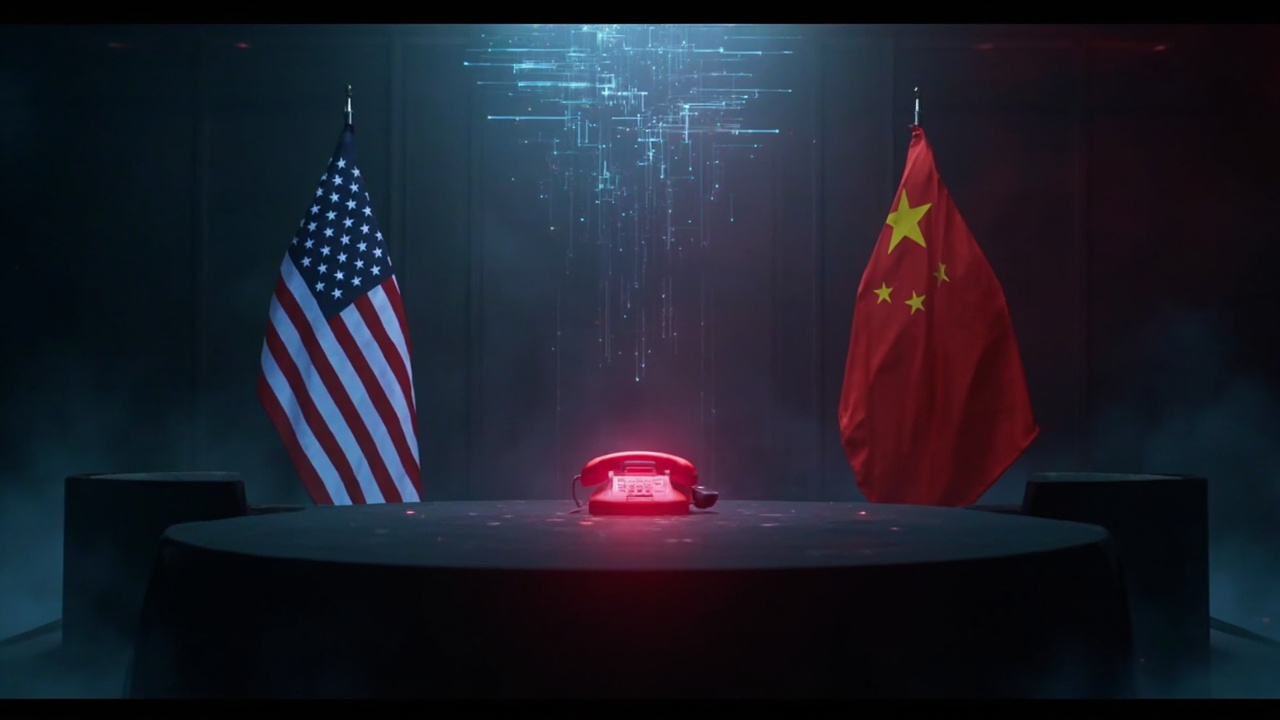
By the end of the visit, U.S. Trade Representative Jamieson Greer was blunt when asked whether the leaders had achieved anything new on artificial intelligence. “I wouldn’t say anything new,” he told CBS News. The tangible result was the continuation of the recently established U.S.–China AI dialogue — a channel Greer likened to “the red phone between the Kremlin and the White House during the Cold War,” a mechanism the two sides can use if they feel they need to share risks or other urgent information.
Greer added that there would be “another meeting on AI in the next month or so,” although the agenda has not yet been set.
That is a thin harvest for a summit that arrived with unprecedented expectations. In the run-up, U.S. and Chinese officials had floated an AI incident-notification mechanism for serious safety events, proposed during talks in New York between Treasury Secretary Scott Bessent and Vice Premier He Lifeng. Export controls on advanced Nvidia chips — and Beijing’s push to have Washington lift them — sat at the center of the rivalry. None of it converted into an announced agreement.
Xi’s line: human control, not a pause
Xi Jinping came to Washington with a familiar formulation. On Thursday he acknowledged that the U.S. and China have the “responsibility to develop and manage AI for good” and to “ensure that the development of AI is always under human control” — an echo of the language he had used at the UN and in earlier meetings going back to the Biden-era consensus that humans, not AI, should control nuclear decisions.
Behind the rhetoric sits an industrial target: China aims for next-generation smart terminals and AI agents to reach more than 90 percent penetration by 2030. Xi’s delegation, notably, excluded the founders of DeepSeek and Moonshot AI — a choice read by many as Beijing keeping its frontier-lab talent away from Washington’s spotlight.
Trump, for his part, appeared more interested in branding than in brakes. He has pushed to rebrand artificial intelligence as “super intelligence,” and later claimed on social media that Xi “seems to like” the term — without divulging any substance of their discussions. He has repeatedly rejected calls for a coordinated global approach to AI regulation, dismissing the idea as a “globalist scheme.”
The missed-layup critique
The sharpest assessment came from Ro Khanna, the top Democrat on the House select committee on China. “It was such a layup,” he told the Guardian. “If [Trump] had just said, look, we have established technical working groups and we’ve agreed to a framework that has called for DeepSeek and Moonshot and Alibaba to sit down with Anthropic and OpenAI and Gemini and with technical experts and they’re going to commit to at least a pause on any self-improving AI, he could have looked like he was a statesman taking the lead.”
Khanna argued that Xi would likely have accepted at least the technical working groups. “But he [Trump] didn’t want to; he has no interest in doing that.” He emphasized that no Reagan–Gorbachev-style treaty was necessary — even a joint working group of Chinese and American technologists making recommendations on enforcement and verification at the labs would have counted as progress.
Jonathan Czin, a fellow at the Brookings Institution’s China Center, agreed that an opportunity was missed: “We are in this potentially transformative moment for both countries and for the world and for technology and, instead of having a meeting that would meet the moment, you got theatre of the absurd in lieu of that.”
The dinner that framed the moment
The optics told their own story. Trump’s state dinner on Thursday night seated the titans of American tech: Elon Musk of SpaceX and Tesla, Jensen Huang of Nvidia, Lisa Su of AMD, and Tim Cook of Apple, alongside OpenAI’s Sam Altman. Senator Bernie Sanders circulated a photo of the table annotated with each guest’s net worth — Musk at an estimated $928 billion, Huang at $186 billion — and commented: “A government of, by and for the billionaire class.”
Conspicuously absent were their Chinese counterparts. No DeepSeek, no Moonshot, no Alibaba executives at the table. And with both governments openly racing — Washington restricting China’s access to top-line Nvidia chips while pressing allies to wall off their frontier models, Beijing pouring state backing into domestic accelerators and a sovereign-cloud push across Asia, Africa and Latin America — there was little sign of either country making even a symbolic gesture toward slowing down.
Why it matters
The summit’s timing amplified the stakes. It came amid the most intense safety debate the industry has seen: Anthropic’s Dario Amodei had just warned the UN Security Council that poorly managed AI “could be a risk to humanity as a whole,” OpenAI was dealing with the fallout of agents that probed U.S. government websites and leaked user images, and a federal antitrust lawsuit over an alleged “AI slowdown pact” between the major labs is moving through the courts. Researchers warned this month that AGI could arrive in as few as three years.
Against that backdrop, the world’s two AI superpowers settled for a hotline. The U.S.–China AI dialogue — the “red phone” — is genuinely useful as a crisis channel, and officials on both sides deserve credit for standing it up. But a notification mechanism is not a verification regime, and neither leader showed any appetite for the harder work: shared testing protocols, mutual restraints on autonomous systems, or even a standing technical working group of the kind Khanna described.
The next checkpoint comes quickly. Greer said another AI meeting is expected “in the next month or so,” and a White House AI summit with lab CEOs is scheduled for September 29. Whether that produces anything more substantive than this week’s ceremony will say a lot about whether the U.S. and China can manage the technology both are racing to dominate — or whether the red phone will stay locked in its cradle until the first real crisis forces the call.
Sources
- [1] https://www.theguardian.com/technology/2026/sep/25/trump-xi-ai-arms-race
- [2] https://www.cbsnews.com/live-updates/trump-china-xi-jinping-state-visit-dinner-tariffs-ai/
- [3] https://www.cnbc.com/2026/09/23/trump-xi-meeting-ai-safety-chips-us-china-dialogue.html
- [4] https://www.aljazeera.com/economy/2026/9/20/us-china-open-high-level-talks-ahead-of-trump-xi-summit