China Now Runs Over 2 Million Factory Robots — and Half the World Makes Them
A BBC on-the-ground report finds more than 2 million industrial robots at work in Chinese factories, fueled by a shrinking workforce and a $20 billion state plan.
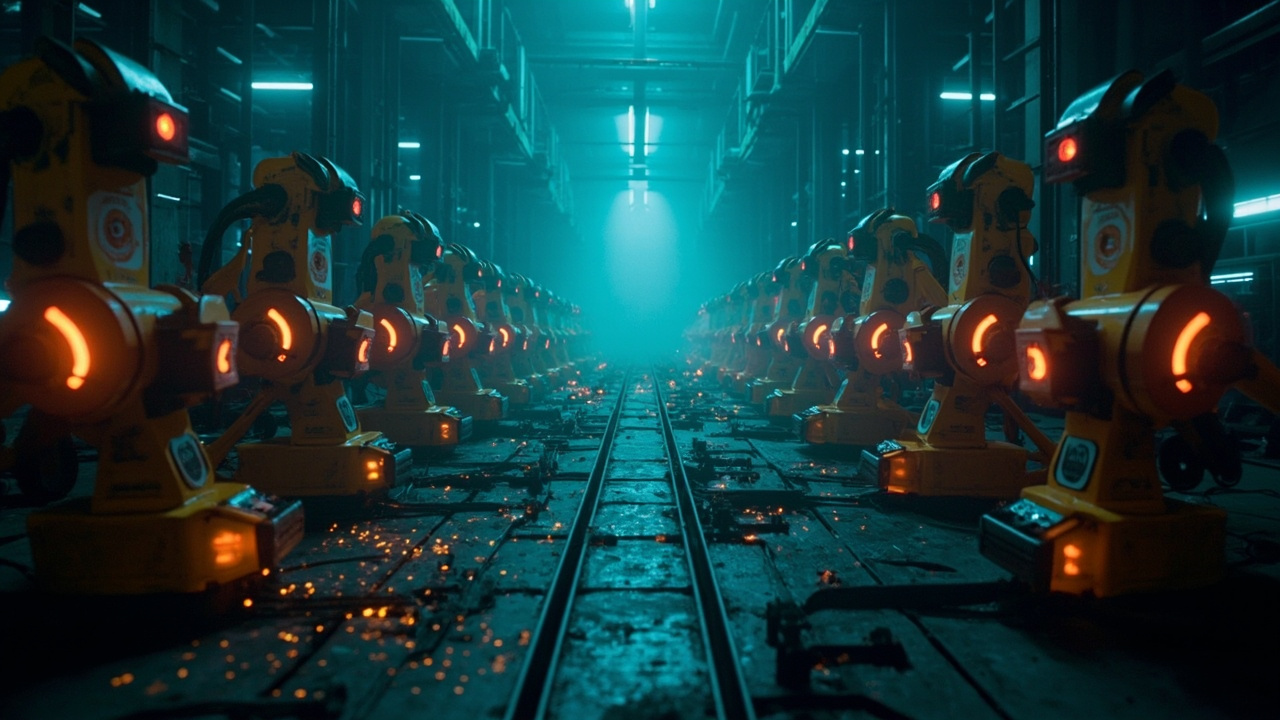
While China’s humanoid robots box, sprint, and dance at showcase events like the World Humanoid Games, a much quieter — and arguably far more consequential — machine revolution is unfolding on the country’s factory floors. A new BBC on-the-ground report from Beijing, Hangzhou, and Chengdu reveals the scale of it: more than two million industrial robots are now working in Chinese factories, more than anywhere else on Earth, and they are being deployed at an extraordinary pace.
The numbers behind the trend are staggering. According to figures cited by Pandaily, Chinese factories produced 773,000 industrial robots in 2025, and 538,000 more in the first half of 2026 alone — up 28 percent year on year. More than half of all industrial robots in the world are now manufactured in China. What was once a market dominated by Japanese and German suppliers has decisively shifted eastward, and the country that once earned the nickname “world’s factory” for its human labor is re-earning it with mechanical arms.
Why Beijing is in a hurry
The driving force behind the automation surge is demographic, and it is unforgiving. By 2035, official estimates suggest more than a third of China’s population will be over 60. Some projections hold that the country will lose nearly 60 million people over the next decade — a figure almost equivalent to the entire population of France. The manufacturing sector still employs around 120 million people, and the hope in Beijing is that machines can fill the looming gap in the workforce before it starts to bite an already sluggish economy.
This is the practical face of what Xi Jinping calls China’s “new productive forces,” backed by a state plan worth roughly $20 billion (£14.7 billion) designed to put the country at the forefront of innovation in direct competition with the United States. It is not a vague slogan — it shows up in purpose-built vocational schools, subsidised factory upgrades, and an supply-chain ecosystem that is the envy of the world.
Dr Susanne Bieller, General Secretary of the International Federation of Robotics, told the BBC that China’s advantage lies in both scale and planning. “China also has an idea. It has a plan. They know where they want to be in five years. They plan at a top level, but they break it down to the regions, to the municipalities,” she said. Her most striking comparison: “If you want to build a robot in Shenzhen — there’s an entire ecosystem. It takes you less than one hour to source the components you need to make a robot. In Europe it can take you up to a week.”
Inside the factories
The BBC’s reporting paints a picture of old and new working literally side by side. At CRP Technology in Chengdu, an assembly line of around 30 middle-aged workers screws, drills, and polishes the company’s signature product — robotic arms that can be tailored to build cars, electronics, or wind turbines. The 300-person firm says a single arm can be programmed to perform more than 90 percent of repetitive industrial tasks. In the same room, young engineers tinker with a prototype designed for an even stranger job: building other robots. It currently manages only simple movements, such as scanning a QR code. “Maybe in another half year, it can do another task,” smiles R&D engineer Pang Kai.
The motivation is bluntly stated. “We need these kinds of robots because maybe in 10 years, we won’t have enough workers in China,” Pang told the BBC.
At EV maker Leapmotor — whose budget-friendly, tech-heavy cars are increasingly popular in Europe and the UK — automation is already deeply embedded in the Hangzhou factory. Vice-president Cao Li acknowledges the trade-offs: machines can work 24 hours a day but still require daily maintenance and monthly line inspections. Yet when asked whether the hundreds of human workers performing final checks might one day be unnecessary, his answer is matter-of-fact: “It’s entirely possible. And it may come relatively quickly. In workshops, including stamping, welding, and painting, we’ve basically achieved 100% automation.”
Training the generation that replaces itself
Perhaps the most poignant scenes in the report come from the Hangzhou Technician Institute, one of many huge vocational campuses built to churn out tech-savvy engineers. Students can enroll from age 15; the campus has an entire building dedicated to engines and aeronautics, plus a restricted floor where students learn rare-earth processing — another crucial front in the rivalry with Washington.
Chen Tianyu, a 28-year-old teacher, spends his spare time visiting automated factories to keep his curriculum current. His message to students is unsentimental: “If you are not needed by the world of AI and robotics, then you’ll definitely be among those eliminated.” With youth unemployment stubbornly high — one in five young Chinese struggle to find a job — these schools offer a rare guarantee; Chen says his students are “pre-booked” by companies before graduation.
Body versus brain
The BBC report lands on a framing that analysts increasingly accept: China is winning the race to build the robot body, while the US still leads in building the brain — the AI that programs and controls machines. But the gap on the intelligence side is narrowing faster than expected, helped by China’s open-source AI culture. Firms from DeepSeek to Moonshot keep releasing models that compete with top American labs, despite US export controls on advanced chips. As the report notes, the next leg of the race will likely be decided not by who has the best language model, but by who can embed that intelligence into millions of physical machines.
The risks are as real as the ambition. Move too slowly, and demographic decline hollows out the workforce. Move too quickly, and job losses among the 120 million manufacturing workers could deal a catastrophic blow to the families and local economies that depend on factory wages — all while China grapples with a property crisis, heavy local government debt, and persistently weak consumption.
“I take a nap and the world changes,” Chen Tianyu shrugs. For the world’s largest manufacturing nation, the world is indeed changing — one robot arm at a time. The question that no one in the BBC’s reporting could answer is whether the two million machines already on Chinese factory floors will create broad prosperity, or simply arrive before the people they replace have anywhere else to go.