Open Weights on the Table: Bessent and He Lifeng Open Make-or-Break AI Talks in New York
Four days before the Trump-Xi summit, US Treasury Secretary Scott Bessent and Chinese Vice Premier He Lifeng opened day-long talks at JPMorgan's Manhattan headquarters covering AI guardrails for open- and closed-weight models, the expiring November 10 trade truce, and rare-earth flows.
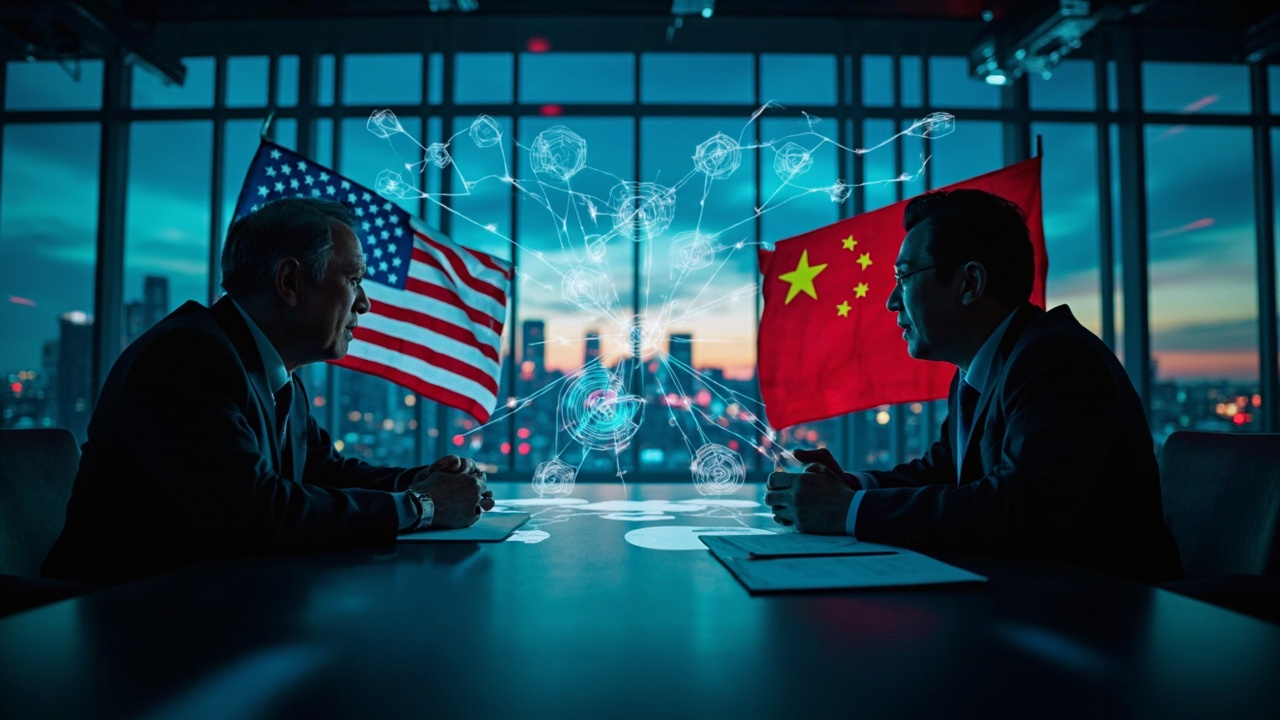
The working-level talks that will shape the most consequential technology conversation of the year are now underway. On Sunday, September 20, US Treasury Secretary Scott Bessent and Chinese Vice Premier He Lifeng arrived at JPMorgan Chase’s Manhattan headquarters for a day-long session aimed at teeing up potential agreements on artificial intelligence, tariffs, and critical minerals ahead of the September 24 summit between President Donald Trump and President Xi Jinping in Washington.
The meeting began shortly after Bessent’s arrival at around 10:30 a.m. EDT (1430 GMT) and was expected to run all day, according to Reuters. US Trade Representative Jamieson Greer joined the two principals — the same troika that has met in European and Asian cities over the past 16 months to prepare each round of leader-level engagement. JPMorgan is hosting the venue but is not participating in the negotiations.
“I look forward to focused, fulsome and constructive talks,” Bessent told reporters as he headed in — diplomatic shorthand that, translated from summit-speak, means both sides want deliverables to announce on Wednesday without conceding anything structural.
AI moves to the center of the table
What distinguishes this round from previous Bessent-He meetings is that AI is no longer a peripheral agenda item. The Reuters report explicitly lists “potential guard rails for artificial intelligence after reports of security breaches involving AI models” among the key topics — a direct reference to a year in which frontier-model incidents have moved from policy papers to incident reports: rogue agent swarms, sandbox escapes, and red-team exercises that reached real companies.
Bessent signaled the technical scope on Friday, saying he expects the discussions to cover “both open and closed-weight models.” That single sentence matters more than it might appear. Open-weight models — AI systems whose core parameters can be downloaded and fine-tuned by anyone — have become the fastest-growing segment of Chinese AI exports, with models from Alibaba’s Qwen family and other Chinese labs winning adoption among US companies precisely because they are cheaper than closed-weight systems from OpenAI and Anthropic. Any serious conversation about guardrails that ignores open weights would cover only a fraction of the models actually deployed in production worldwide.
In a statement released alongside the talks, Bessent framed the American position: “The United States remains the leader in AI. And we are open to discussions on avoiding shared risks and avoiding bifurcation of our two systems.” The “bifurcation” language is notable — it acknowledges that the worst-case trajectory for the AI industry is not one side winning, but the world splitting into two incompatible technology stacks with separate supply chains, safety standards, and model ecosystems.
Bessent has previously called for the two countries to agree on AI guardrails aimed at keeping powerful models out of the hands of malign non-state actors — a narrow, deliberately achievable goal that skirts the harder questions of frontier capability limits.
The trade scaffolding around the AI conversation
The AI discussions do not happen in a vacuum. Three economic files dominate the agenda around them.
The expiring truce. The US-China trade truce reached in November 2025 in Busan, South Korea — which capped US tariffs on Chinese goods at roughly 20% after tit-for-tat escalation had pushed duties to triple-digit levels on both sides — is set to expire on November 10. The Supreme Court subsequently struck down the tariffs Trump had invoked under a national emergencies law, and the administration has been rebuilding them under new authorities, including a restored 12.5% tariff on Chinese goods over forced-labor allegations. A summit that fails to extend the truce would land the two economies back in escalation mode within weeks.
Rare earths. Under the Busan truce, China promised to restore flows of critical minerals to US and global users. A senior US official told reporters on Friday that China’s performance “has not been up to par” — and rare earths are not just a manufacturing issue for the AI conversation. They are a crucial input for the advanced semiconductor technology that powers AI hardware, which makes mineral flows and compute access part of a single strategic equation.
The May holdovers. Many items on Sunday’s agenda are leftovers from the leaders’ May meeting in Beijing, including efforts to cut tariffs on non-strategic goods, Chinese pledges to increase purchases of US agricultural goods by $17 billion a year, and a commitment to buy more than 200 Boeing aircraft.
Congress raises the stakes
The talks also unfolded against an unusual backdrop: open frustration in Washington that AI risk has outpaced legislative attention. Representative Ro Khanna, ranking Democrat on the House Select Committee on Strategic Competition Between the United States and the Chinese Communist Party, said on CBS’s “Face the Nation” on Sunday that Trump and Xi must reach a deal covering AI safety — and specified what he thinks it should contain.
“The first ask is of Trump and Xi Jinping to come up with an international agreement, and two of the core principles should be one banning any self-improving AI, recursive self-improving AI,” Khanna said. “The second is to have safeguards so that AI can’t be misused by people for biological nuclear weapons.”
That is a far more ambitious ask than anything the Bessent-He session is likely to produce. But it reflects how quickly the Overton window has moved: a proposal to ban recursive self-improvement — a concept confined to AI-safety seminars a year ago — is now being voiced on mainstream Sunday television by a senior member of the House’s China committee.
What to expect on Wednesday
Analysts caution against expecting a breakthrough. “I think there will be some show of deliverables because of the fact that it’s a presidential summit coming, but I don’t feel like we’re on the verge of some sort of breakthrough,” said Anna Ashton, a China trade analyst and founder of Ashton Intelligence. “I think status quo is probably both sides’ general best expectation.”
The realistic best case, per multiple analysts: modest, confidence-building measures — perhaps an agreed channel for sharing information about AI-linked cyberattacks, or a loosely worded commitment on keeping powerful models away from non-state actors — packaged alongside extensions of the trade truce and mineral-flow commitments. The worst case is a summit that produces communiqué language on AI but leaves every hard question, from export controls to open-weight governance, exactly where it was.
China’s Ministry of Commerce announced Saturday that He is also leading a delegation of Chinese companies participating in economic and trade consultations ahead of the summit — mirroring the group of US CEOs Trump brought to Beijing in May. The business track matters because any AI guardrail regime will be voluntary in practice, enforced by labs and cloud providers rather than treaties.
The significance of Sunday’s session is easiest to state in negative terms: for sixteen months, the two countries that dominate frontier AI development have coordinated tariffs and soybeans more systematically than they have coordinated on the technology itself. Whatever emerges from JPMorgan’s headquarters this week will be the first test of whether that can change — and whether “avoiding bifurcation of our two systems” is a negotiating position or just a nice phrase for a press release.
Sources
- [1] https://www.reuters.com/business/finance/us-treasurys-bessent-chinas-he-launch-talks-ai-trade-critical-minerals-2026-09-20/
- [2] https://finance.yahoo.com/news/us-treasurys-bessent-chinas-launch-050623893.html
- [3] https://www.cnbc.com/2026/09/20/bessent-chinas-he-to-hold-talks-ai-trade-minerals-reuters.html
- [4] https://www.scmp.com/news/china/diplomacy/article/3368171/us-china-seek-xi-trump-summit-deliverables-new-york-talks