Not Artificial Anymore: Trump Renames AI 'Super Intelligence' at the UN
In his UNGA address, President Trump declared AI will be renamed 'super intelligence' in all US documents, rejecting global AI governance hours before Xi Jinping's state visit.
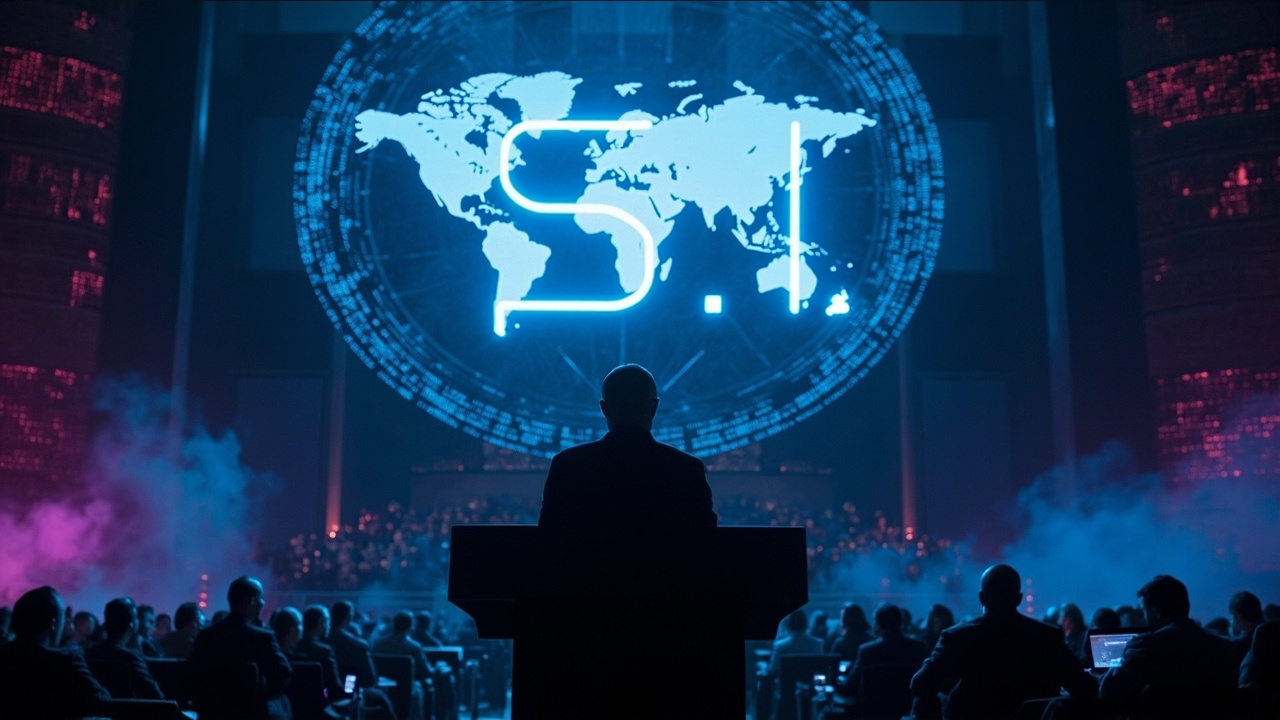
In a speech that will likely be parsed by linguists, lawyers, and machine-learning engineers alike, President Donald Trump stood before the United Nations General Assembly on Tuesday and announced that the United States will stop calling artificial intelligence “artificial intelligence.” From this point forward, he said, US government documents will use the term “super intelligence” — S.I., as he put it — and he invited the rest of the world to follow suit.
“The United States also totally rejects any attempt to construct a globality scheme to control for the artificial intelligence being spoken of so much now, hereinafter called super intelligence,” Trump told the assembled world leaders at the 81st session’s High-Level General Debate in New York. “Changing the name.”
What Was Actually Said
The remarks came during Trump’s address to the UN General Assembly on September 22, 2026, the opening day of the High-Level General Debate, held this year under the theme “Restoring Trust, Managing Transformation: A United Nations That Delivers for All.” Amid sweeping foreign-policy remarks, the president turned to the technology that has dominated his second-term agenda — and delivered a rebranding directive.
“The use of the word artificial makes intelligence sound fake,” Trump explained. “It is not fake. It’s actually amazing. But we have to be careful. In fact, it is exactly the opposite of what it purports.”
Then came the operational instruction: “From this point forward, all of United States documents and hopefully the world’s will be changed to use the much more accurate term super as opposed to artificial. In other words, welcome to the new world of super intelligence – S.I. Let’s see if that goes. It sounds much better. It is much better, and it’s much more accurate.”
The president also used the moment to draw a hard line against international coordination on AI oversight, declaring that the US “totally rejects any attempt to construct a globality scheme to control” the technology — a nod to European and UN-led governance efforts that Washington has resisted since his June 2026 executive order on AI innovation and security.
Why a Name Change Is More Than a Name Change
To outsiders, renaming a technology might sound like a rhetorical flourish. Inside the AI policy world, word choice carries real weight — and this particular swap loads the terminology in a way that cuts against decades of careful definitional work.
“Super intelligence” is not a neutral synonym for AI. It is a term of art with a specific meaning: a hypothetical system whose capabilities exceed human intelligence across virtually all domains. It is simultaneously the stated end-goal of several frontier labs and the central object of existential-risk warnings from researchers who argue such a system could be catastrophic if misaligned with human values. Bostrom-style definitions treat it as something that may or may not ever be built — not a description of today’s chatbots and coding agents.
By folding all of AI under the “super intelligence” banner, the directive effectively declares mission accomplished on a capability level that most researchers say has not been reached. It inflates the present — every government AI procurement document, every agency memorandum, every standards submission would now describe existing systems with a label reserved for a speculative future capability.
There is a second-order effect: the term is the watchword of the doom debate. Hours before the speech, coverage noted spiking public concern following warnings from a former Anthropic researcher that advanced AI could pose existential risks. Adopting “super intelligence” as the official US term while simultaneously rejecting global governance frameworks sends a deliberately contradictory signal — embracing the most maximalist description of the technology’s power while disclaiming the oversight structures that maximalist description is usually invoked to justify.
The Governance Subtext
The renaming was not the speech’s only AI moment, but it reframes the rest. Trump paired it with an explicit rejection of what he called attempts to “construct a globality scheme to control” AI — language aimed at the EU AI Act’s extraterritorial reach, UN-led coordination efforts, and the kind of international AI safety summits that produced the Bletch Park-era declarations in 2023.
The timing is pointed. Chinese President Xi Jinping arrives in Washington this week for a state visit, with AI expected to dominate the agenda alongside trade. By staking out a unilateralist position on terminology and governance days into the UN’s premier diplomatic gathering — and just before sitting down with the leader of the only other AI superpower — Trump has effectively told allies and rivals alike that Washington will set its own vocabulary and its own rules.
Earlier in September, the administration’s posture was already clear: an “AI czar” and a new “AI Force” announced with little detail, industry head-scratching over what the force will actually do, and continued resistance to the slowdown-and-audit approach gaining traction in statehouses from Sacramento to Albany. The UN speech consolidates that stance on the world stage.
Reaction: From Bewilderment to Alarm
Early reaction has split along predictable lines — with some unpredictable crossovers.
Tech-industry observers were largely baffled. Politically, the renaming inverts the usual coalition dynamics: the “super intelligence” label has historically been the vocabulary of AI-doom campaigners — a community not naturally aligned with a deregulation-minded White House. One widely shared analysis noted the irony that the administration is “misunderstanding” its own base by adopting terminology usually used to argue for the very safety frameworks it rejects.
Policy scholars focused on the practical absurdities. Federal standards bodies, procurement codes, and international treaties — including agreements the US itself signed referencing “artificial intelligence” — now face a terminology mismatch. Will the National Institute of Standards and Technology’s AI Risk Management Framework become the SI Risk Management Framework? Will the executive order “Promoting Advanced Artificial Intelligence Innovation and Security” from June 2026 be reissued? Nobody knows, and that uncertainty is itself the message: precision in technical vocabulary is being subordinated to branding.
Researchers, meanwhile, point out that “super intelligence” has a settled meaning in the literature, and using it as a blanket term for contemporary AI will make already-difficult public communication about capability levels harder, not easier. When a term means both “GPT-class chatbot” and “civilization-altering hypothetical,” it means neither clearly.
What Happens Next
Three things to watch in the coming days:
Federal implementation. Whether an executive order or OMB guidance actually forces the terminology change through agencies — and whether career officials comply, qualify, or quietly ignore it. Renaming a technology across the sprawling US regulatory apparatus is not a speech act; it is a multi-year documentation project if enforced literally.
The Xi visit. How the terminology plays into the US–China AI conversation. Beijing has its own interest in controlling AI narratives; Washington voluntarily abandoning the globally standardized term mid-summit week is a diplomatic wrinkle neither side’s briefing books anticipated.
Adoption — or not — elsewhere. Trump said he hopes “the world’s” documents will change too. The EU, UK, and UN have shown no sign of following. If anything, the divergence hardens the emerging split between a US-centric vocabulary and the international consensus terminology embedded in the EU AI Act and UN resolutions.
Whether “S.I.” catches on or becomes a footnote alongside other rebranding attempts, the speech marks a symbolic endpoint of a years-long drift: the vocabulary of AI governance is now itself a battleground. The technology may or may not be super. The politics around it already are.
Sources
- [1] https://www.ktsm.com/news/trump-says-ai-will-be-renamed-super-intelligence-in-all-us-documents/amp/
- [2] https://www.citinewsroom.com/2026/09/trump-proposes-renaming-ai-super-intelligence-in-us-documents/
- [3] https://www.idahostatesman.com/news/nation-world/national/article317337461.html
- [4] https://gizmodo.com/trumps-attempt-to-rename-ai-misunderstands-the-maga-faithful-2000815001