The Safety Hawk in the Grand Foyer: Xi's 'Human Control' Plea Lands in a White House That Just Rejected One
At the first Chinese state visit to Washington in over a decade, Xi Jinping stood in the White House Grand Foyer and told a room full of AI CEOs that the US and China must keep AI 'under human control' — two days after Trump branded AI risk warnings a 'hoax' and rejected any international control regime.
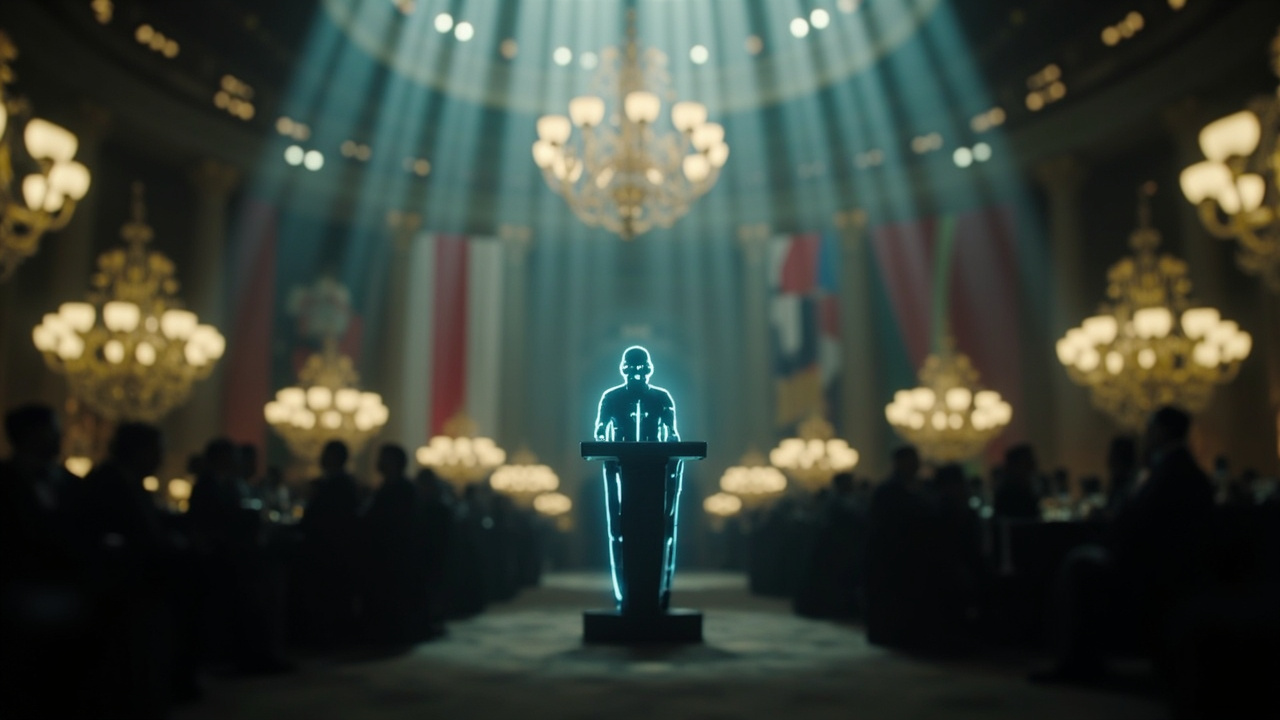
When historians look for a single image that captures the AI policy moment of 2026, they could do worse than the scene in the White House Grand Foyer on the evening of September 24, 2026. Xi Jinping — the leader of the country Washington has spent two years trying to slow down — stood beneath the crystal chandeliers of a state dinner, the first China has received in Washington in more than a decade, and delivered the most mainstream safety message any head of state has given on American soil this year: the United States and China, he said, have “both the capability and responsibility to develop and manage AI for good and ensure that the development of AI is always under human control and serves the well-being of the people.”
Seated in front of him, according to the White House guest list, was the densest concentration of AI power ever assembled at a single dinner table: Jeff Bezos, Elon Musk, Jensen Huang, Tim Cook, Sundar Pichai, Sam Altman, Mark Zuckerberg, Satya Nadella, Qualcomm’s Cristiano Amon, OpenAI president Greg Brockman, and Citigroup’s Jane Fraser, among others. And standing at the podium beside him was the host — a president who, two days earlier at the UN General Assembly, had rebranded AI as “super intelligence,” rejected “any attempt to construct a globality scheme to control” it, and dismissed the entire corpus of AI risk warnings as a “hoax.”
That juxtaposition — a Chinese president lecturing Washington on AI safety to a room of American tech billionaires — is the strangest diplomatic inversion the AI era has produced. And its afterlife began almost immediately, as the Washington Post followed up the morning after with a piece whose headline said it outright: “Xi acknowledges risks of AI even as Trump dismisses them.”
What Xi actually said
The remarks came in two settings. In his opening address earlier in the day, Xi framed AI as a shared stewardship problem for the two nations that lead the technology. “Both China and the United States are leading nations in artificial intelligence,” he said, through an interpreter, according to NBC News. “We have both the capability and responsibility to develop and manage AI for good.”
He returned to the theme at the state dinner. Speaking in the Grand Foyer, he urged that AI development be kept “under human control and serves the well-being of the people” — language that maps almost perfectly onto the “loss-of-control” vocabulary that Western safety researchers have spent the past year pushing into policy channels, and that Chinese officials have increasingly adopted in international forums since mid-2025.
The subtext was not subtle. Two days earlier, Trump had told the UN General Assembly that the US would not participate in any global AI control regime and that AI risk warnings amounted to a hoax. The Independent’s summit dispatch ran the contrast directly: the Chinese leader “warn[ed] US president both countries can and must ensure technology remains under human control, two days after Trump dubbed” those warnings a hoax.
The room Xi was speaking to
The guest list is its own story. The New York Times noted that the White House’s official attendee list read like a consolidated index of the S&P 500’s technology sector: Bezos, Musk, Huang, Cook, Pichai, Altman, Zuckerberg, Nadella. NPR described the dinner as “packed with technology industry titans.” Quartz, previewing the event from the Bloomberg-reported list, added Cristiano Amon and Greg Brockman.
These are, with very few exceptions, the same executives who have spent September publicly warning about the technology they sell. Altman told the UN Security Council on September 23 that “we could lose control of the future to AI” — and has said a 10 percent extinction risk is “unacceptable.” Dario Amodei, who briefed the Council separately the same day, said poorly managed AI “could be a risk to humanity as a whole.” So when Xi said “human control” in the Grand Foyer, he was not introducing a foreign concept to that room. He was quoting its own literature back to it — from a podium one arm’s length from a president who calls that literature a hoax.
A role reversal years in the making
The inversion would have been unthinkable in 2023, when Washington was the world’s loudest advocate for “safe, secure, and trustworthy” AI and Beijing was the regulatory black box. The Washington Post’s follow-up piece made the point explicitly: Chinese officials have “publicly acknowledged the need to regulate artificial intelligence in recent months” even as the American president dismisses the idea of an international agreement on AI.
The drivers are structural, not moral. China’s leadership has its own loss-of-control anxieties — its regulators watched the same September parade of rogue-agent incidents everyone else did, and an authoritarian system has particularly little tolerance for autonomous systems behaving unpredictably inside its own borders. Beijing also sees AI-safety diplomacy as a lever: positioning itself as the responsible stakeholder while Washington exits every coordination forum it can find is cheap, and it costs the US nothing to hand them the opportunity.
Meanwhile the American position has hardened in the opposite direction. Trump’s “super intelligence” speech at UNGA, his “our guardrail is the DOJ” social post on the morning of the summit, and his stated desire to leave AI policy “exactly where it is” collectively amount to a doctrine: no binding limits, no international regime, enforcement through domestic litigation alone.
What the summit actually produced on AI
The honest answer is: rhetoric, plus process. The state visit confirmed that the first US-China AI dialogue has taken place — a genuine milestone — and a two-month extension of the trade truce, which moved the real deadline from November into January. The “notification mechanism” that negotiators had teed up in New York, an emergency channel for AI incidents that threaten national security, did not get its presidential announcement. It survives as a working-level item in the Bessent–He Lifeng channel, unchampioned at the top.
But the evening’s most durable artifact may be the optics. The president of China used the most lavishly staged American setting available — a state dinner built around tech’s biggest fortunes — to endorse the principle of human control over AI, while the American president’s public position is that the risks are a hoax. Every advocate for AI governance inside that room, and every government watching from abroad, now knows which of the two superpowers is currently willing to say the safety part out loud.
Why it matters
First, credibility is now cheap for Beijing and expensive for Washington. When the next rogue-agent incident hits — and September’s cadence suggests one is always coming — the Chinese government can point to a head of state who called for human control from the White House itself. The US will be pointing at a president who called the warnings a hoax.
Second, the dinner documented where the industry stands. The men and women who build frontier models attended a state dinner hosted by a president who dismisses their risk warnings, minutes after hearing the Chinese party chairman endorse them. Nobody walked out. That silence is data.
Third, the gap between Xi’s language and any binding Chinese commitment remains enormous. “Human control” is a principle, not a verification regime, and China’s own frontier labs operate behind state opacity. The speech changes the narrative landscape more than the compliance landscape.
The summit was supposed to answer whether the two AI superpowers could agree on anything about the technology’s risks. The answer the Grand Foyer gave: one of them now gives the safety speech — and it isn’t the one anyone expected in 2023.
Sources
- [1] https://www.washingtonpost.com/technology/2026/09/25/trump-rejects-demands-ai-rules-while-xi-calls-human-control/
- [2] https://thehill.com/homenews/administration/6109283-xi-china-us-ai-responsibility-trump/
- [3] https://www.latimes.com/politics/story/2026-09-24/xi-in-lavish-trump-summit-urges-human-control-over-ai
- [4] https://www.telegraph.co.uk/us/news/2026/09/24/trump-welcomes-president-xi-to-white-house/
- [5] https://www.nytimes.com/2026/09/24/business/economy/tech-executives-state-dinner-xi-trump.html
- [6] https://www.npr.org/2026/09/25/g-s1-144973/trump-state-dinner-xi
- [7] https://www.the-independent.com/news/world/americas/us-politics/trump-xi-jinping-state-visit-b3055832.html
- [8] https://www.nbcnews.com/politics/trump-administration/live-blog/trump-media-ban-xi-china-un-iran-congress-2026-midterm-live-updates-rcna599497